An exploration
Borrow the Water
Putting the water to work on its way to the Dead Sea
These explorations weave memory and present thinking — not records of what happened, but attempts to learn by holding the past and the present in the same frame. Why it reads this way →
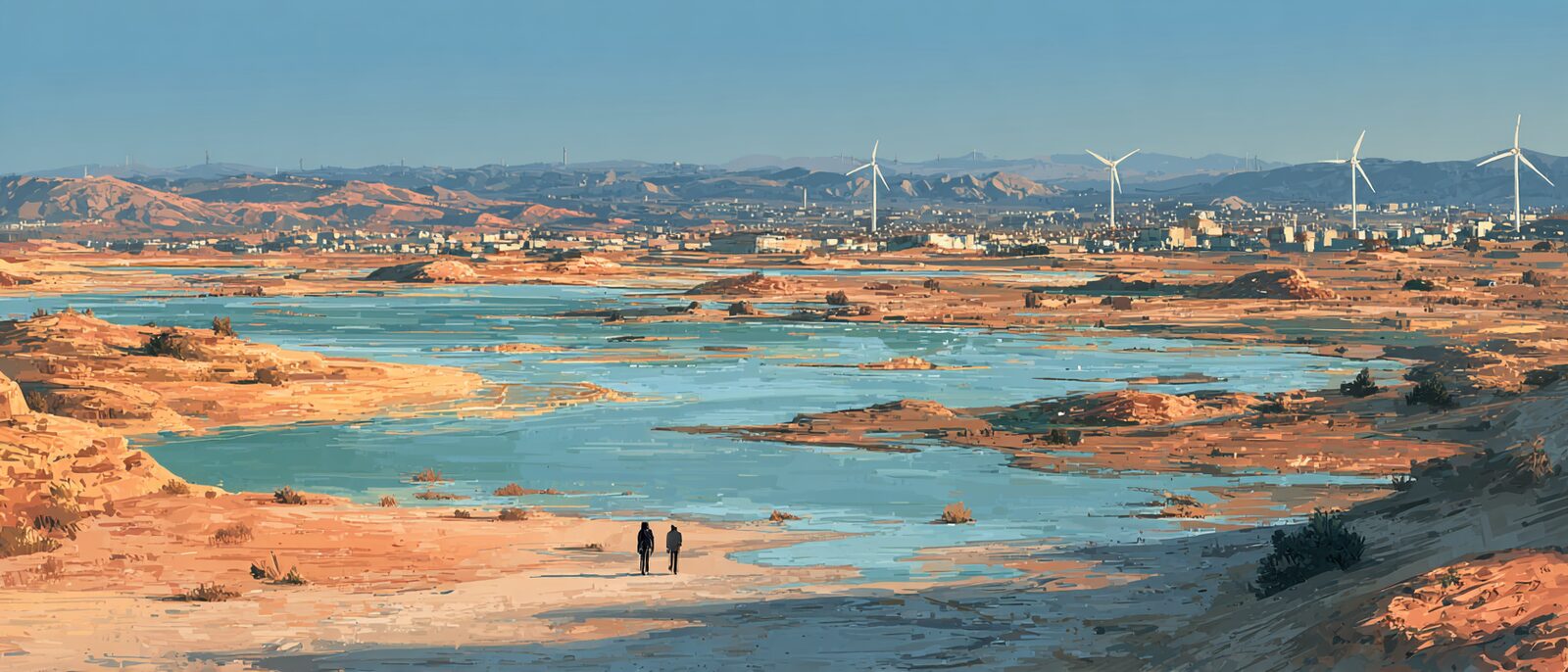
Water runs down the Jordan Rift Valley toward the Dead Sea, and there it ends. The sea has no outlet. The water arrives, sits, evaporates, and leaves its salt behind. By the time it reaches the bottom of the valley it is saline, terminal, and — in the way we usually think about water — already lost.
We treat saline water as waste. Too salty to drink, too salty for most crops, on its way to a sea that will only make it saltier. The instinct is to ignore it and go looking for fresh water somewhere else — which, in Jordan, is a search with very few happy endings.
But water is not lost until you waste it.
The question that started this was not how to find more fresh water. It was simpler, and stranger. What work could the water we already have do on its journey — even saline, even on its way to a sea that was always going to take it?
Borrow, don't consume
Most water strategy is about ownership and consumption. Who holds the rights. Who draws it down. Who uses it up. The valley invited a different verb. Not consume. Borrow.
Water moving through a landscape can be put to productive use and then passed on, much of it continuing its journey, having done something useful on the way. The salt that makes it useless for one purpose makes it ideal for another. The constraint is the opening.
The algae
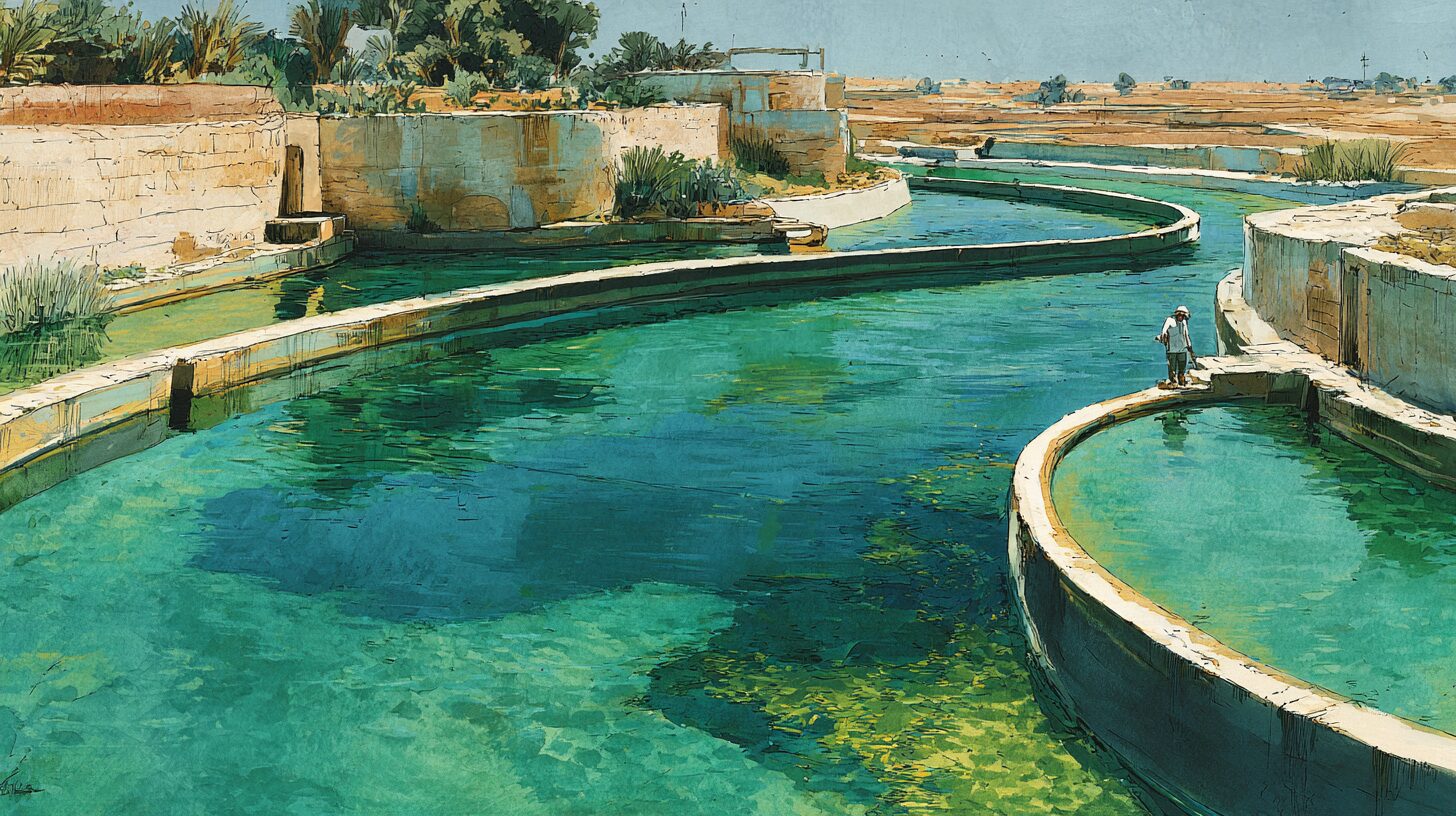
The clearest example was algae. Saline and brackish water, useless to a wheat field, is exactly what certain algae want. Grown in ponds and closed systems through which the water passes, algae turns sunlight and saline water into oil — vegetable oil that can become biofuel — and into high-protein biomass that becomes cattle feed and fish food.
The efficiency is what stops you. Set against the land needed to produce a unit of energy from corn, algae is in another category entirely.
So the same saline water that the valley was carrying down to the Dead Sea could, on the way, grow oil for fuel, feed for livestock and food for fish — and then continue. Not one harvest from the water. Several, as it travels.
The algae idea did not arrive in the valley. It arrived years earlier, through Chris Glasow — a serial entrepreneur who came to us to see what we might do together. We worked first on something quite different: intelligent internal-environment control, interpreting how a person actually defines comfort — temperature, humidity, the position of the blinds for shade, air velocity — rather than reducing it to a single thermostat setting.
It was Chris who brought algae into it, through a UK Government bio-chemicals initiative. We ended up looking at how algae could clean the residue from food production. The story we were told — and took enormous delight in — was that baked-bean residue was fed to algae, which then yielded the base compound for cosmetics. Expensive face treatments, it turned out, came largely from baked beans.
That thinking ran on into a waste-water treatment proposal for the Solar Island scheme at Regensburg, and later into Solar City Linz. Algae, we kept finding, was less a crop than a converter — it would take what a system discarded and hand back something valuable. The Jordan Valley simply offered it the perfect feedstock: not waste, but salt and sun and water on its way to the sea.
A landscape that gives more than once
Once you stop thinking of water as something to be used up and start thinking of it as something to be borrowed, the valley changes shape. The salt is a resource. The desert sun is a resource. The descent toward the Dead Sea is a resource — a long productive gradient rather than a drain.
Energy comes off the same ground that grows the algae. Heat and brine and biomass become feedstocks for other processes. The land that everyone had written off as too dry, too salty and too low becomes, precisely because of those qualities, the most interesting land in the country.
The most productive water
This remains a proposition, with all the usual caveats — the economics are hard, the engineering is real, and salt is as corrosive to equipment as it is to assumptions. But the core move has only grown more relevant as fresh water has grown scarcer.
Do not ask only how to find more water. Ask what the water you already have can do before it goes. Borrow it. Let it work as it passes. A sea was always going to take it in the end.
The most productive water in the valley may turn out to be the water everyone else had already written off.
From the Studio — sources & confidence
With thanks to Akram Abu Hamdan — the award-winning, AA-trained Jordanian architect who brought the Valley of Opportunity to us from the Royal Court, and who has done so much to shape urban regeneration across Jordan through The Urban Foundation. The 2008 masterplan was developed with Foster + Partners; the algae thinking began earlier with Chris Glasow.