An exploration
Cynefin
We did not lose the land. We lost the knowledge of where the value sits and how to keep it.
These explorations weave memory and present thinking — not records of what happened, but attempts to learn by holding the past and the present in the same frame. Why it reads this way →
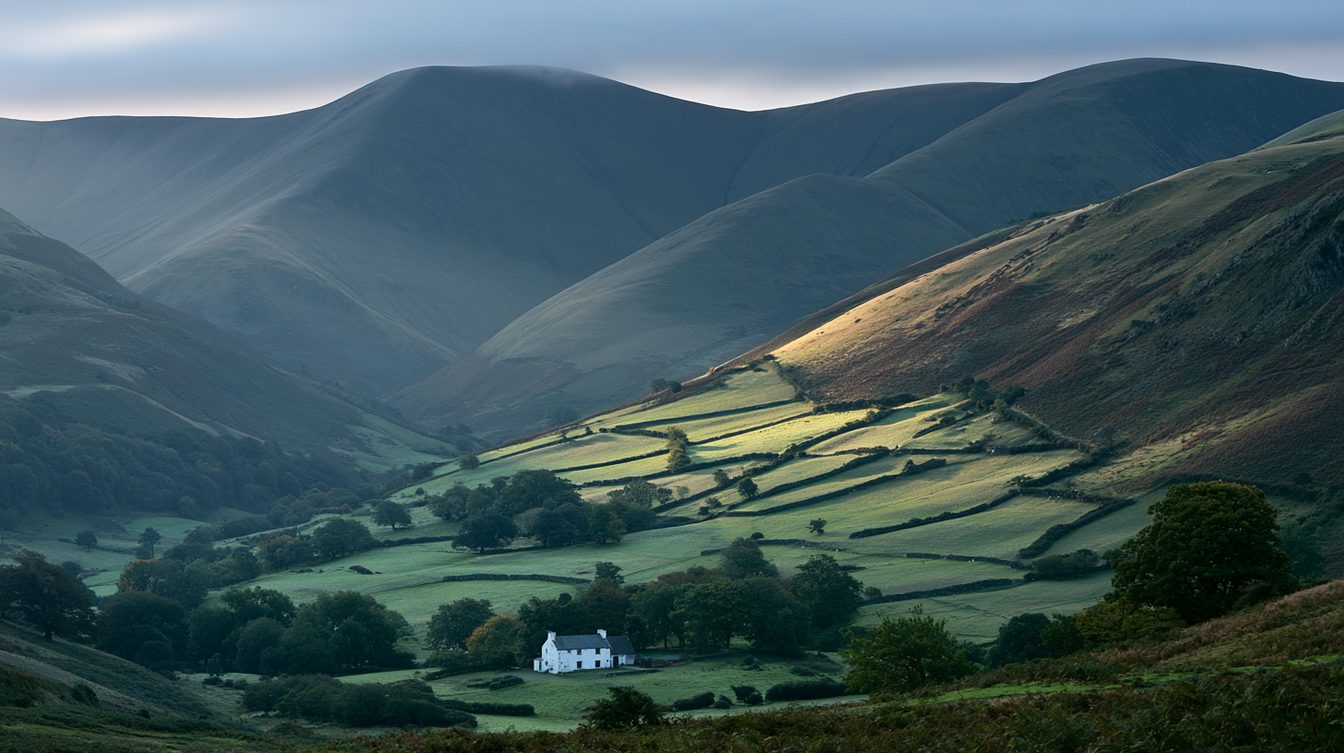
There is a Welsh word, cynefin, that the dictionaries translate as “habitat” and the shepherds use to mean something more exact. It is the patch of mountain a flock knows as its own — where to graze in which month, where to shelter when the weather turns, where the ground is sound. The knowledge is not written down. It is carried in the animals and the family together, handed from one generation to the next by walking the ground. A hefted flock does not need fences because it already knows where it belongs.
I have been turning over the history of who has owned the land in Wales, and how they worked it, and I keep arriving back at that word. The story we usually tell about Welsh land is a story of loss — the farms sold, the families gone, the supermarkets squeezing what is left. And the more carefully I look, the more I think that story is true in its mood and wrong in its facts. We did not, in the end, lose the land. We lost the cynefin — the coordination, and the knowledge of where the value sits and how to keep it. That is a harder thing to see than a sold farm, but it is also, unlike the past, a thing we can get back. This is a thought piece, not a prospectus; some of it is conjecture and some of it will be wrong. But the shape of the argument has become clear to me, and the shape is more hopeful than the mood.
The assumption I started with
The assumption almost everyone starts with — I did — is that the decline of Welsh farming is fundamentally a story about ownership: that the land slipped out of local hands, and that getting it back is the repair. It is a powerful story because it rhymes with a real history of dispossession. But when you lay the centuries out end to end, the ownership story does something unexpected. It refuses to run in a straight line.
The land has changed hands many times before
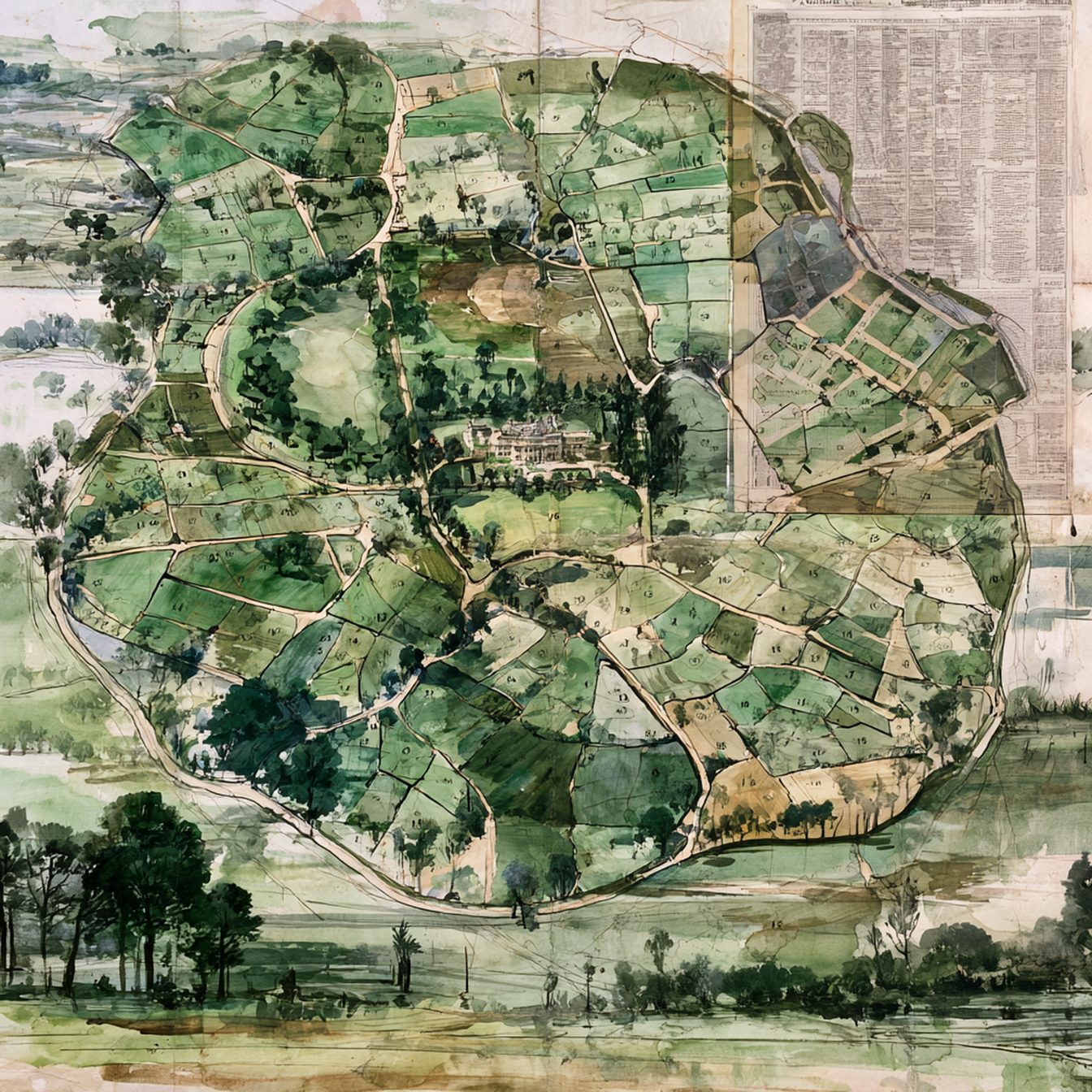
Go back far enough and Welsh land was held not by individuals but by kindreds. Under the old law attributed to Hywel Dda, land passed by cyfran — partible inheritance, divided equally among all the sons — and was held by the joint family, the gwely, as something the bloodline shared rather than something a person owned and sold. It made for endless fragmentation, and historians fault it for weakening the Welsh princes against the Norman habit of leaving everything to the eldest. But notice the shape: the land was held in common and worked in portions.
Then it concentrated. The Cistercian abbeys — Strata Florida, founded in 1164, ran its sheep through some fifteen granges — built great pastoral estates on top of the older kindred geography, and by the eve of the Dissolution the monastic houses held perhaps a third of all the land in England and Wales. When Henry VIII dissolved them between 1536 and 1540, that land did not return to the commons; it passed through the Crown to a rising class of gentry, and the great Welsh estates were born. By 1887 something like nine in ten acres of cultivated Welsh land sat inside landed estates, worked by tenant farmers who owned almost none of it. This was the peak of concentration, and it produced the bitterness you would expect — the Tithe War, the evictions, the Welsh Land Commission of the 1890s convened to ask why the people who farmed the land had no stake in it.
And then it swung back. After the First World War the estates broke up in a sell-off so large that contemporaries reached for the Dissolution and the Norman Conquest to find a comparison — a quarter of England was said to have changed hands in four years. In Wales the buyers were, overwhelmingly, the sitting tenants. The late historian John Davies put numbers on it: land that was around ninety per cent estate-owned in 1887 was, by 1970, about sixty-two per cent owned outright by the farmers who worked it. The tenant became the freeholder. By the measure everyone reaches for first — do local people own the land? — the twentieth century was an age of restoration, not loss.
So the ownership story, followed honestly, does not deliver the conclusion it promises. The land came back.
The land came back; the value left
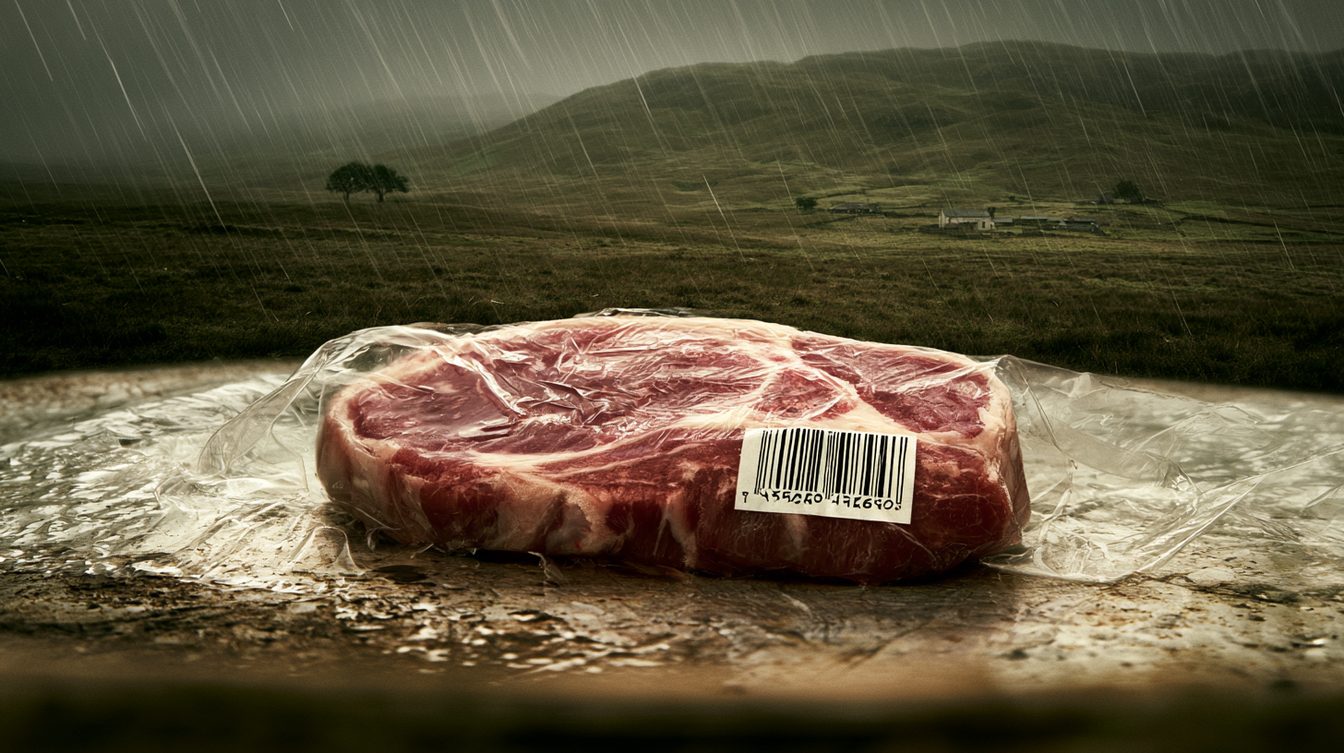
If the farmers got their land back, why does it still feel like defeat? Because something else left while we were watching the title deeds. The value migrated — off the land, down the chain, to the far end where the food is sold.
The four biggest chains take around two-thirds of British grocery sales, and the eight biggest more than nine in ten. That concentration sits at the opposite end of the chain from a hundred thousand scattered farms, and the gap between what the farmer is paid and what the shopper pays tells the story — lamb leaving the farm at well under half what it fetches on the shelf. The one safeguard, the Groceries Code Adjudicator, protects only suppliers who deal with the retailer directly, which most farmers do not — they sell through a processor, on the far side of the protection.
This is the reframe the whole history turns on, and it took me embarrassingly long to see. The medieval concentration was a concentration of land. The modern one is a concentration of value, and it does not need to own a single field to work. A farmer can hold the freehold his great-grandfather bought back in 1919 and still be a price-taker on his own produce, because the thing that was taken this time was not the acre. It was the coordination — the relationships and the market position that decide where in the chain the money settles. We have been guarding the deeds and leaving the till open.
Two ways to bring it home
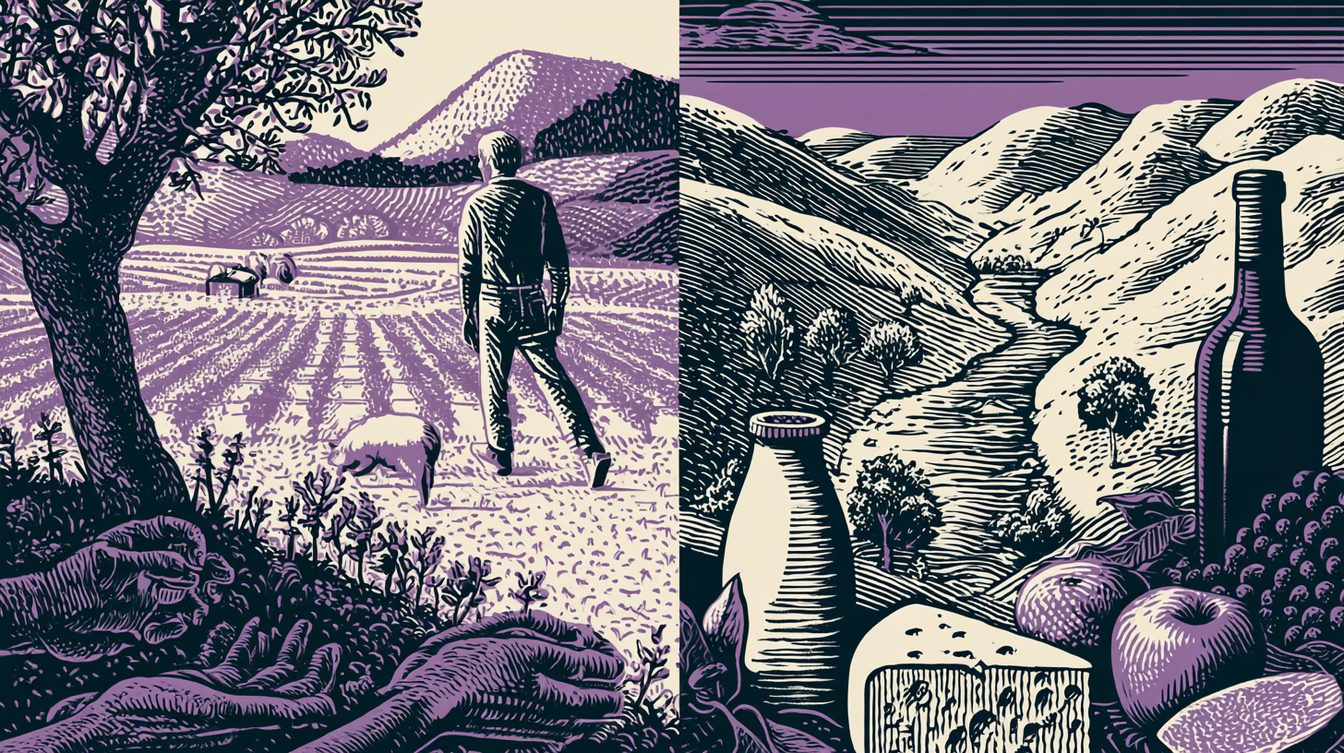
Put like that, the repair stops being mysterious. If the value leaks out along the chain, there are only two honest ways to bring it back — and they are not rivals but two levers on the same machine. The first is to shorten the distance: find the eater closer to the field, so fewer hands take a cut on the way and more of the price stays near the farm. The arithmetic is plainer than I expected — hold the shelf price of a lamb where it is and split it evenly between growing it and selling it, instead of the third-to-two-thirds split we have now, and the farm’s return rises by something like forty-five per cent without the shopper paying a penny more. The second lever is to deepen the value before it leaves — to do more of the making in the valley: not raw milk but cheese, not a tray of fruit but juice and preserve, not a carcase but the cut and cured thing. Every step of that processing is value, and value accrues where the work is done. A crop of raspberries is worth little by the tray; raspberry cordial made in the same valley is worth a great deal more, and the difference stays home.
Neither lever is a slogan, and both have a catch I will come back to. But notice what they share, because it is the quiet hinge of this whole essay: the instrument that pulls either lever is the one the land kept reaching for anyway — farms acting together. A single hill farm cannot build a short supply chain or a processing kitchen; a dozen of them, pooling the function while each keeps its own ground, can. The cure for the value that left turns out to be the same shape as the cure for the land that fragmented. Hold your own; work it together. That is not a new idea imported from a business school. It is the gwely.
The hands that hold it
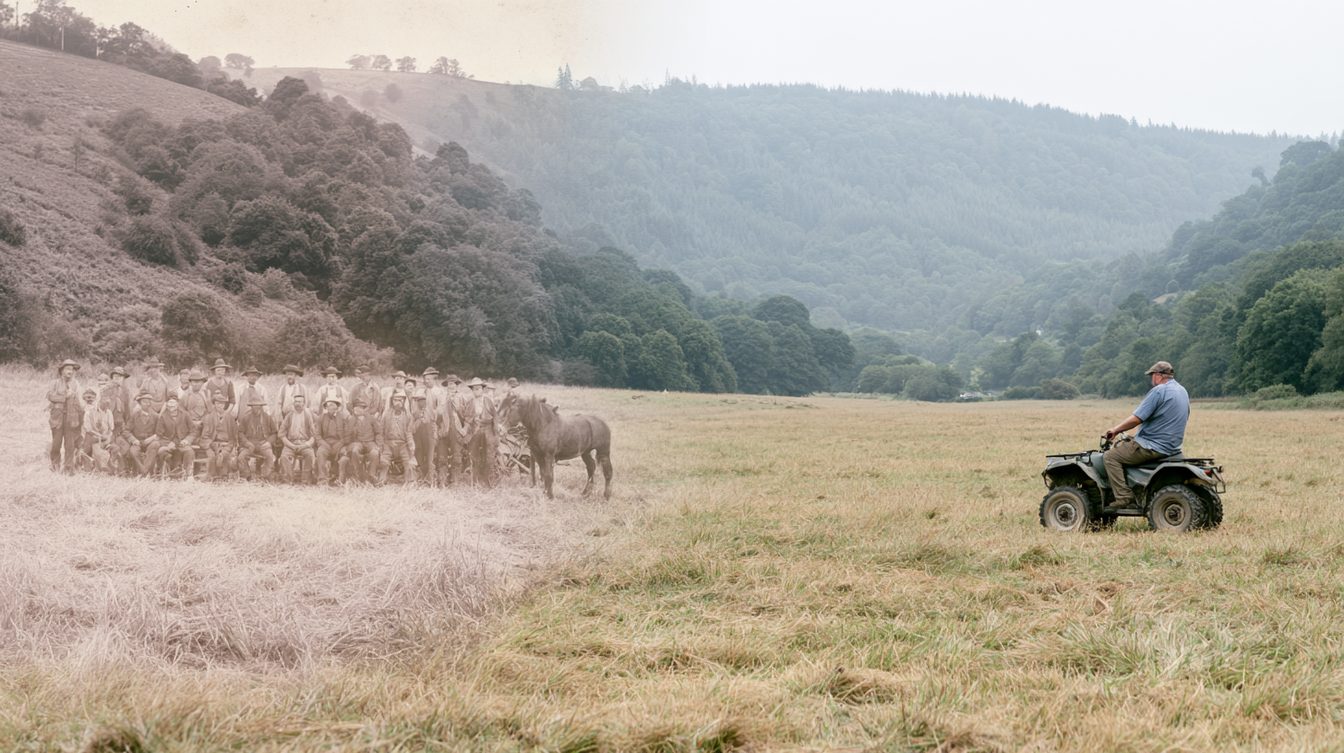
There is a second emptying underneath the first, and it is the one that worries me most. The land used to hold people. At the census of 1851 there were roughly three agricultural labourers for every farmer; over the following half-century, as machinery arrived and cheap imported food undercut the home crop, that workforce drained away — the proportion of farm labourers in England and Wales fell by more than a third between 1871 and 1901 even as the population grew by nearly half. The drain never really stopped. Today the whole of Welsh agriculture employs around twelve thousand people on its farms, alongside some thirty-seven thousand farmers and their partners — and more than half of those are part-time, holding the farm together with a wage from somewhere else. The land that once supported three workers to a farmer now barely supports the farmer.
And that farmer is getting old. The average Welsh farmer is now about fifty-nine, and barely three in a hundred are under thirty-five; across these islands as a whole something like two in five are sixty-five or over. Behind the averages is a quieter fact: a large cohort of owners is reaching the end of working life with no one obviously coming after them. The father-to-son handover that carried the cynefin down the generations is not gone, but it is strained, and it is narrower than it looks — not least because “father to son” has always under-counted the daughters and the newcomers who could carry it just as well.
This is the moment the long oscillation reaches again. A wave of ageing owners with no heir is a shock to who controls the land, exactly like the Dissolution and the post-war sell-off before it. Left to itself it will swing as those did when no one shaped them: holdings amalgamated into larger units, sold to investors, planted up for distant carbon accounts — concentration, one more time. But a shock to ownership is always also an opening, and here is the idea that only came clear once I set the two halves of this story side by side: the handover is the install point. The cheapest moment to re-found a farm on a model that keeps its value — a shared short chain, a co-owned processing step, a younger pair of hands — is precisely the moment it changes hands anyway. We will get one of these windows a generation. It would be a waste to spend it simply moving deeds around.
The repair is older than the problem
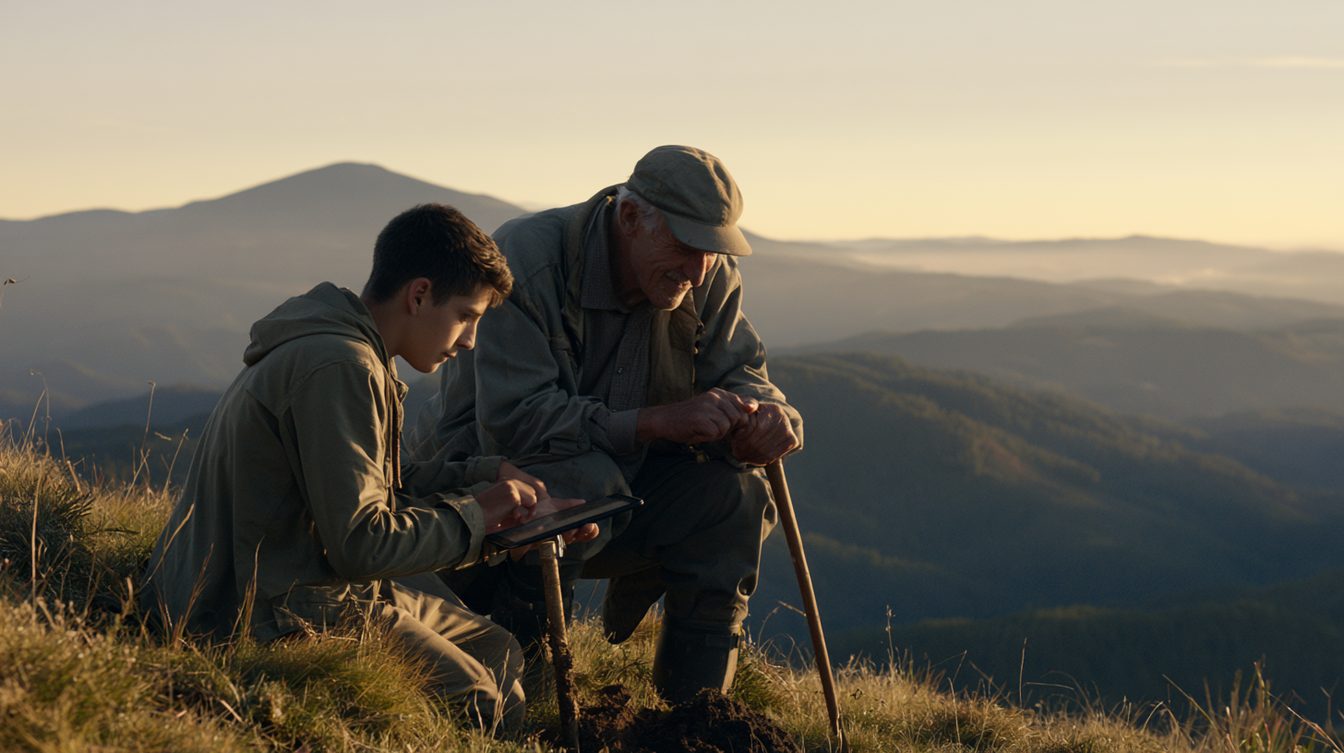
The repair, then, is the oldest pattern in the whole story, the one the land keeps returning to whenever it is allowed: hold the land in common, work it in portions. The gwely did it by kinship. The granges did it by aggregation. The hafod a hendre — the old transhumance that took the stock up to the summer pasture in May and brought them down in November — did it by sharing a seasonal rhythm across the commons. And the work was shared too: cymhortha, the custom by which neighbours gathered to get in each other’s hay and harvest, made cooperation a duty rather than a favour. Each of these was a way of separating the holding of land from the working of it, so that no single pair of hands had to own everything in order to farm.
That same move is alive right now in a valley on the other side of the world, in a piece I wrote earlier this year about the Jordan Rift. There the problem is the mirror image — plots fragmented by inheritance, too small to carry investment — and the answer that kept surfacing was: keep the title, pool the function. Let each family keep its deed but share the machinery, the scheduling, the marketing — and, I would now add, the processing and the route to market. Don’t consolidate the land; consolidate the doing. Access, not ownership, is what the next generation needs, because ownership is the one thing they cannot afford. And it is not a thought experiment: Wales already runs the matchmaking through Farming Connect’s Venture, now Start to Farm, pairing owners who want to step back with new entrants who have the skill but not the acres; Ireland’s Land Mobility scheme does the same; New Zealand built a whole ladder to ownership out of sharemilking.
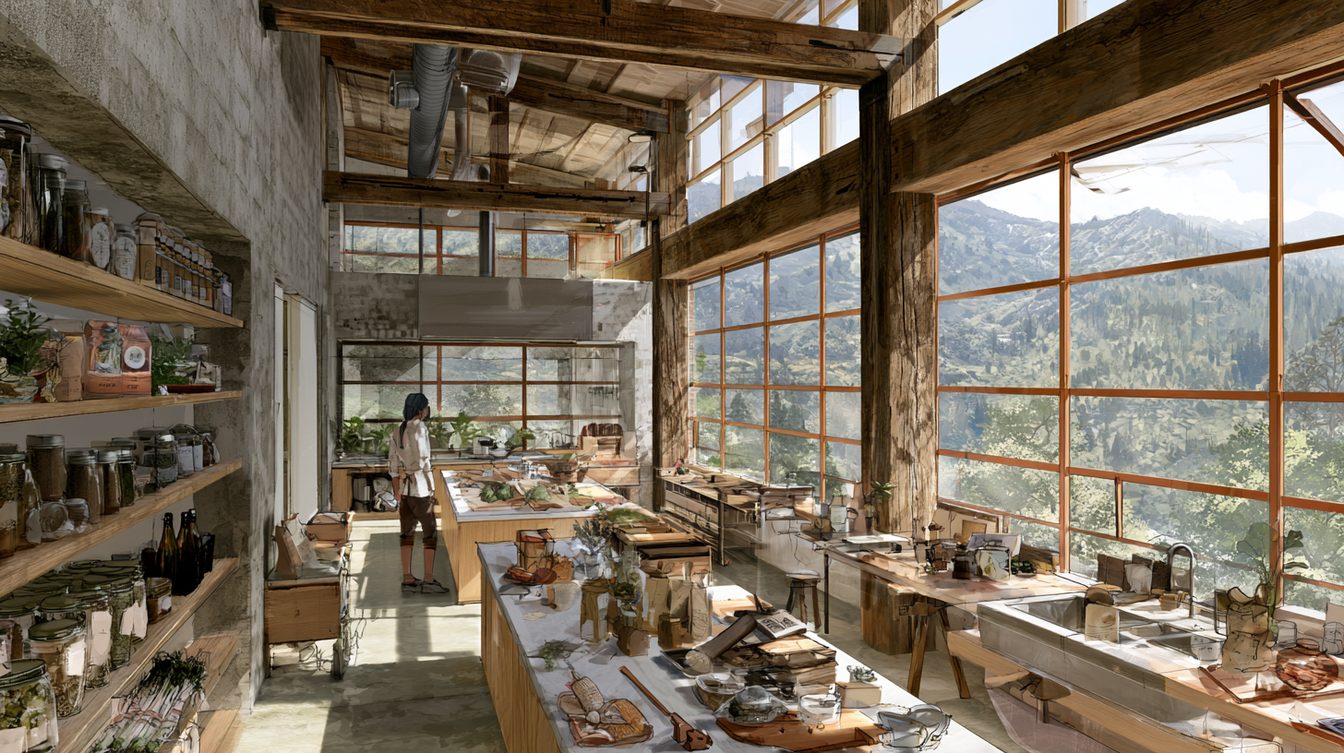
The more I look, the more I think the encouraging part is how much of the apparatus already exists. Wales has built the food-innovation centres where a co-op could process; it has the provenance machinery and the trade fairs; and it is the first nation in the world to make the Foundational Economy — keeping wealth circulating locally, “the local pound” — an explicit goal of government. There are even working proofs: a scheme putting local organic veg into two hundred Welsh primary schools, redesigning a supply chain to be shorter and fairer on purpose. The scaffolding is up. What is mostly missing is the wiring back to the farm — and that is a more hopeful problem than an empty field.
The objection I take seriously
I want to state the case against all of this at its strongest, because agreeing with the objection is what keeps the idea honest.
That I am romanticising the commons: I am not entitled to. The gwely was kinship, not community; it had its bonded and its free; and cyfran was genuinely destabilising — the fragmentation was a real weakness, not a lost utopia. That distribution is not the same as flourishing: the estates, for all their injustice, often supplied the capital and breeding and drainage the smallholder could not, and when they broke up some of that capability went with them — the new freeholders of 1919 were frequently under-capitalised and squeezed. Getting the land back did not, on its own, make anyone prosper. That is the warning at the centre of another piece in this notebook, The Market That Closed: you can build the infrastructure and still fail if the relationships are not there. Title without coordination is just churn — and, I would add, a processing shed full of chutney nobody buys is worse than selling raw. The matching schemes are no panacea either: New Zealand’s classic fifty-fifty sharemilking, the rung everyone points to, has actually been declining as land prices rose, and Wales’s Venture has made only around seventy-five matches since 2015, against twenty-five thousand holdings. A mechanism can exist and still not carry the weight. None of it works if the newcomer simply inherits the same broken economics that drove the last generation out. The succession repair and the value repair have to move together, or neither moves at all.
I hold all of that openly. It is exactly why the answer cannot be a slogan, and why the how deserves a piece of its own.
Don’t train them to inherit the old job
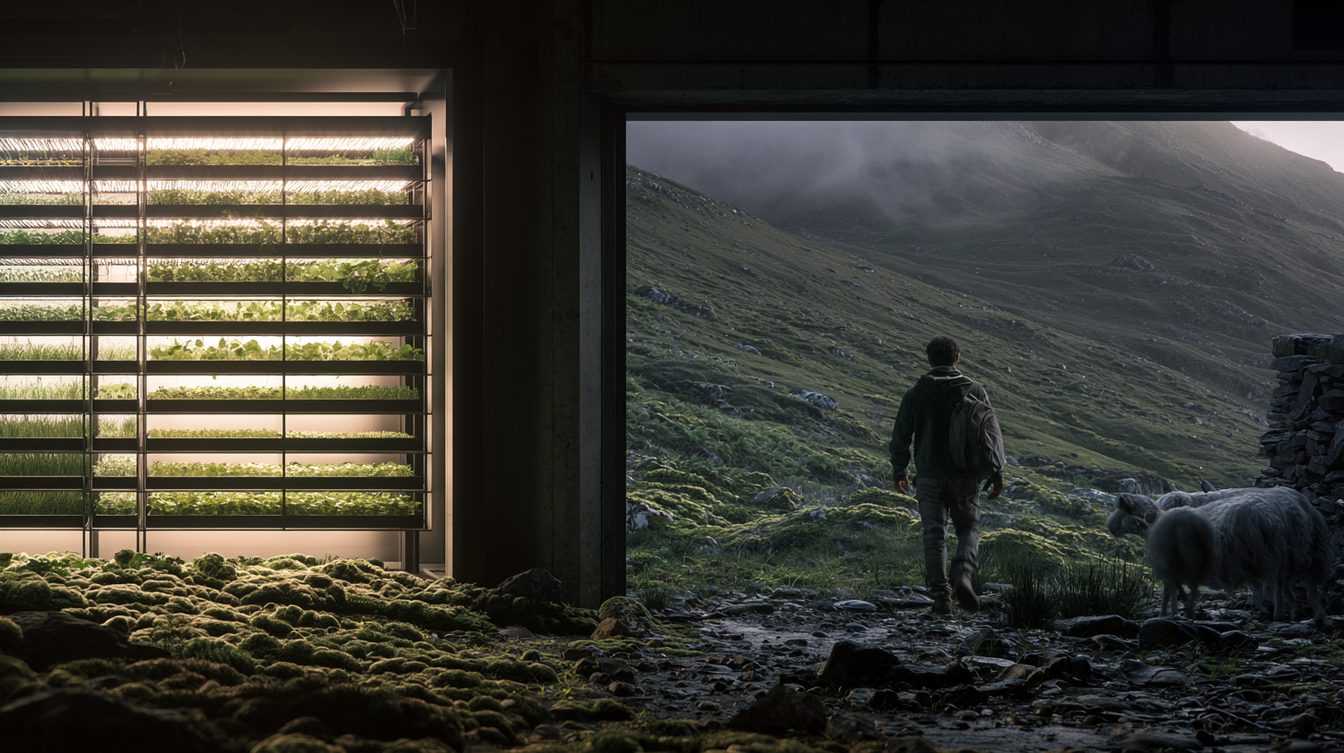
There is one more turn, and it is the one that makes me most hopeful. Part of why the handover is failing is that the job being handed over has become unattractive — hard physical work, long hours, poor pay. Only about four in a hundred young people work in food and farming, yet nearly four in ten say they would consider a career in it. That gap is the whole opportunity. The mistake would be to train young people to inherit the old job. The opening is to design new ones: the entrant who comes to an ageing holding as a data and precision-growing specialist; as a market-garden grower feeding a short local chain; as the manager of the processing or the agroforestry the older farmer has neither the time nor the appetite to learn. Technology here is not the thing that empties the land of people — done honestly it is the thing that gives a skilled young person a reason to come back, and the means to make and keep value locally rather than watch it drain away. The catch, kept in view: technology can cut headcount as easily as raise it, and much of rural Wales still cannot get a reliable signal across a farm. The new role only counts if it adds people and keeps value home.
What I would actually do — and what comes next
The smallest honest version of all this is a single valley. Find a cluster of neighbouring holdings where the owners are ageing and willing; bring in new entrants on keep-title-pool-function terms through the matching that already exists; give each a designed new role rather than the old manual one; add one processing step the farms own together; and wire the produce into a short local chain — a school, a hospital, a box scheme — so the value is kept at the farm end instead of surrendered at the shelf. Then measure it the way the Jordan piece taught me: not by income alone but by whether the farmers renew for a second season, because renewal is the real proof that the thing is trusted, and trust is what the commons always ran on. If they do not renew, the structure is wrong, and you change the structure rather than scold the people. That is the kill switch, written in before the start.
It might not work — the economics might not close, the matching might stay too small, the attachment to doing it alone might prove stronger than the case for doing it together. I hold that possibility the way I hold all the others here. But even a serious attempt turns the succession wave from a thing that happens to Welsh farming into a thing Welsh farming does.
We have spent a long time believing we lost the land. We mostly did not. What we let slip was the cynefin — the shared knowledge of where to stand and how to work the ground together so that it holds people and keeps its value.
The land came back; the knowledge can too. How exactly we keep the value — the length of the chain, the depth of what we make, the system that attributes it fairly, and the half-built Welsh scaffolding already waiting to be wired to the farm — is a longer answer than this piece can carry. It is the subject of the next one. For now it is enough to say that the repair is not an import and not a novelty. Like the flock that still knows its mountain, it is only dormant, waiting to be walked again.
From the Studio — the wager behind this piece, and where it connects · sources & confidence
The wager, stated so it can be judged: the modern loss in Welsh farming is not of title but of value and coordination — and the cooperative form (keep title, pool function) is the single instrument that repairs both the fragmented ownership and the leaked value at once. That central reading is my own, offered as conjecture rather than proof, and it is owed the single-valley test set out above: stand up one farmer-owned processing step on keep-title-pool-function terms, wire it into a short local chain, and judge it on whether the farmers renew for a second season — if they do not, the structure is wrong, and that is the kill switch written in before the start. Where it connects: it extends the wales-land-arc, reappears in a-field-held-in-common (the Jordan mirror of the same move), the-walking-economy and farm-in-a-box, is challenged by the-market-that-closed (you can build the infrastructure and still fail if the relationships are not there), and runs on into its sequel, How We Keep the Value.
Sources & confidence. The present-day figures are Grade A against their primary sources: grocery concentration (Kantar) [A]; the farmgate-to-retail lamb gap (AHDB) [A]; the Welsh farmer age profile — average ~59, ~3% under 35 (House of Commons Welsh Affairs Committee, 2025) [A]; Welsh farm employment and holdings (StatsWales June agricultural survey) [A]. The Foundational Economy and Welsh-veg-in-schools facts are Grade A/B from Welsh Government and Food Sense Wales sources. The historical arc is Grade B — strong and cross-referenced but resting on secondary scholarship; the spine figures (the ~90% estate ownership of 1887, ~62% owner-occupation by 1970, the post-war sell-off) rest on John Davies’s calculations and lift toward Grade A against the now-identified primary records — the 1873 Return of Owners of Land (the “modern Domesday”, digitised and linkable) and the 1896 Royal Commission on Land in Wales [B→A]. The one figure kept deliberately illustrative is the 50/50 split [C]. The central reading — that the modern loss is of value and coordination rather than title, that the two levers are distance and depth, and that the cooperative form repairs both — is the author’s own, owed the single-valley test above. Underlying theses in the reasoning graph: wales-land-arc, wales-land-succession, the-length-of-the-chain, distance-and-depth, welsh-foodtech-landscape, a-field-held-in-common, farm-in-a-box, the-walking-economy, the-market-that-closed, places-we-bury-value.