An exploration
It Takes a Village to Build a House
What if the housing crisis is really a community crisis?
These explorations weave memory and present thinking — not records of what happened, but attempts to learn by holding the past and the present in the same frame. Why it reads this way →
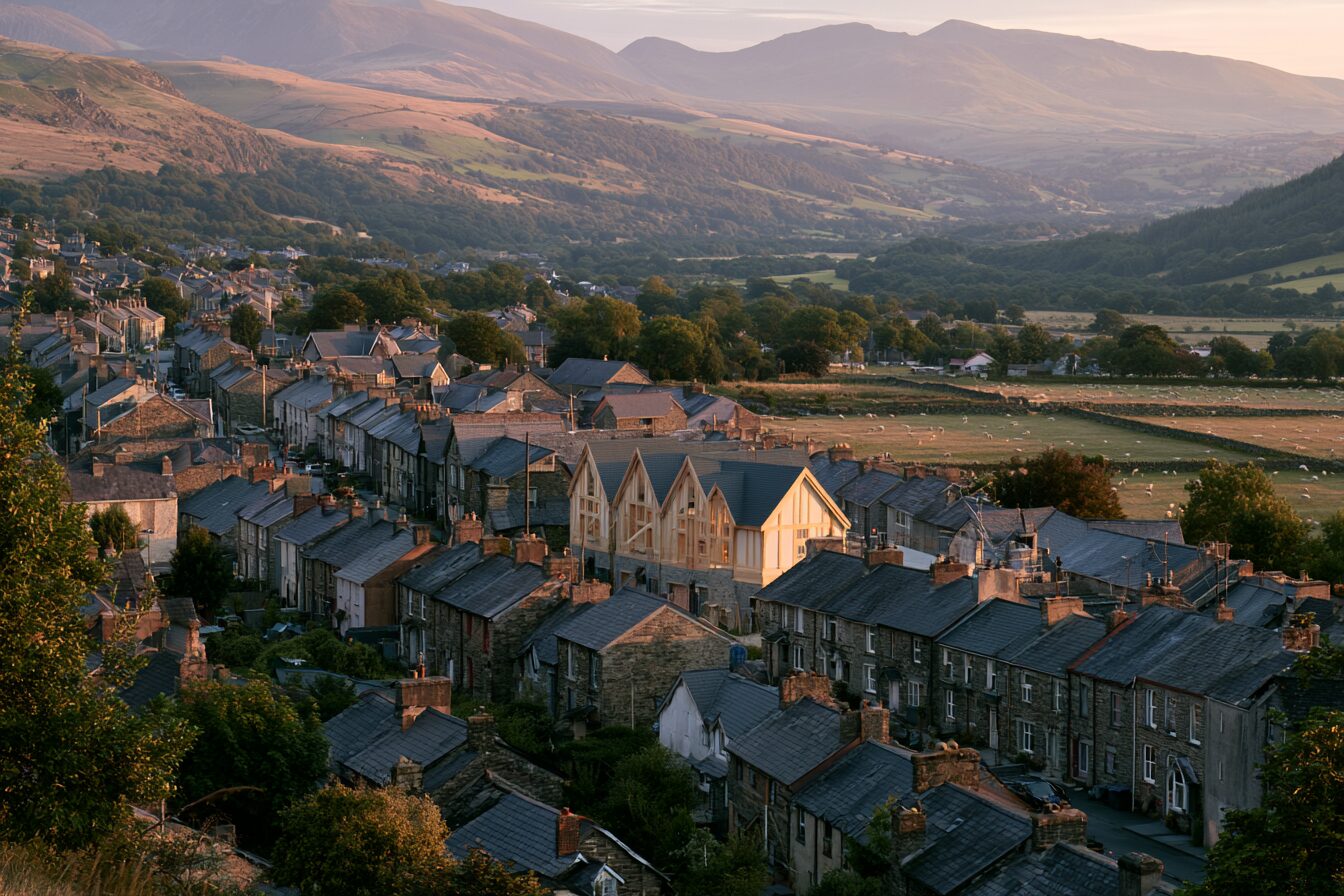
On the edge of many Welsh towns there are fields that have not changed for generations. Sheep graze. Dry-stone walls mark old boundaries. Footpaths cross the landscape much as they always have. Yet a few hundred metres away, young families struggle to find somewhere they can afford to live.
Older residents stay in houses that no longer suit them because there is nowhere appropriate to move to. Employers cannot recruit because housing makes relocation impossible. Schools lose pupils. Shops lose customers. Slowly, a community becomes less able to sustain itself.
The conventional response is simple: build more houses. Yet after decades of housing policy, planning reform, grant programmes and developer-led construction, many places live with the same problem. Perhaps the question is not how many houses we build.
Perhaps the question is what kind of housing system we are building.
Looking beyond the house
A house is usually treated as a product — something designed, financed, built and sold. Viewed differently, housing is infrastructure. Just as roads allow movement and energy systems allow power to flow, housing allows a community to reproduce itself across generations.
Without affordable homes there are no young families. Without young families there are no schools. Without schools there are fewer jobs, less spending, weaker local businesses. The housing system is not separate from the community. It is one of the foundations community capability rests on.
This is starkest in rural Wales, where local wages have separated from local house prices. The average home in Wales now costs around six times median earnings, and in counties like Gwynedd the gap is wider still. Homes increasingly become investment assets, retirement destinations or holiday lets rather than places that enable local life. The result is not only higher prices. It is the slow weakening of the fabric that lets a place function.
A different question
Most housing debates begin with supply: how do we build more homes? A more useful question may be — how do we create a system that produces affordable homes continuously, generation after generation?
The distinction matters. One focuses on projects. The other focuses on capability. A development of fifty homes solves a problem once. A local housing ecosystem keeps solving it for decades. The challenge becomes less about construction and more about creating the conditions through which housing can be delivered, again and again.
Learning from community housing
Across the UK and Europe, communities are taking a more active role in shaping housing. Community Land Trusts. Housing co-operatives. Mutual home ownership societies. Cohousing. Self-build groups. The models differ, but they share a principle: the community participates not only as occupants but as owners, stewards and decision-makers.
In a Community Land Trust the land is held in trust and taken out of the speculative market; resale is capped by formula so the home stays affordable for the next family, and the next. Solva, in Pembrokeshire, did exactly this; LILAC in Leeds tied people's equity to their income rather than the market. The aim is not to maximise financial return. It is to maximise community benefit.
The question becomes: how can housing keep serving the place, rather than extracting value from it?
Five homes a year
There is something powerful in small numbers. Housing policy mostly operates in thousands — national targets, regional allocations, large developments. But many communities do not need thousands of homes. They need a steady flow.
Imagine a town creating five homes a year. Five does not sound transformative. Yet over a decade it is fifty, and over twenty, a hundred. More importantly, it creates continuity. Skills develop. Local suppliers emerge. Finance becomes familiar. Governance matures. Young people can see a path into construction and design. Instead of periodic bursts of activity, the community builds an enduring capability — closer to how a healthy ecosystem works: not sudden abundance, but continuous renewal.
The timber beneath our feet
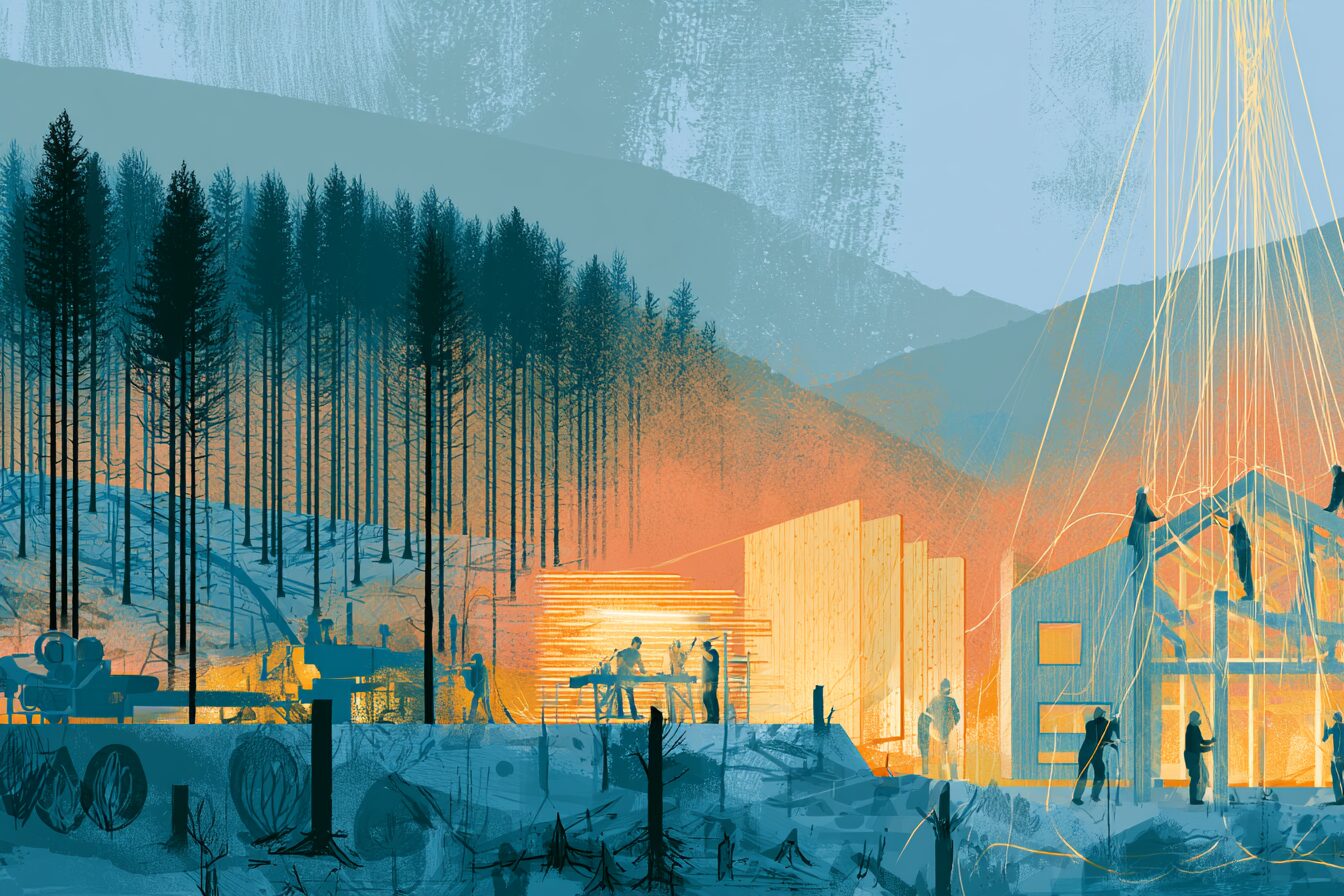
Woodland covers about an eighth to a sixth of Wales, yet much of what we grow leaves as a relatively low-value commodity — fencing, pallets, board, biomass — while construction-grade timber is largely imported. The irony is sharp: the UK imports roughly four-fifths of the wood it uses, and communities buy in expensive building products while exporting one of the raw materials needed to make homes. Historically, Welsh timber built houses, barns, ships and infrastructure. Today much of that value is created elsewhere.
What if housing helped rebuild a local timber economy? Modern engineered timber — cross-laminated timber, laminated veneer lumber — can make efficient structures, store carbon, lower a building's embodied emissions, and suit off-site manufacture and modern methods of construction. More importantly, it creates regional value chains: forests, sawmills, fabrication, design practices, builders, training providers — linked by a common purpose. Housing becomes not only an outcome but a mechanism for strengthening the wider local economy.
A new apprenticeship
A recurring rural challenge is the loss of practical skills. Young people leave to study and work elsewhere; firms struggle to recruit; traditional crafts get harder to sustain. Housing offers an answer. What if every community housing project were also a learning project?
Local colleges take part. Apprentices gain real experience. Students work with digital design tools, timber fabrication, energy systems and modern methods. Retired tradespeople mentor the next generation. Knowledge that might otherwise disappear stays embedded in the place. The homes matter — but the skills may matter more.
Housing as social infrastructure
A further shift comes when housing is seen as a system rather than as isolated units. An older resident moving into a suitable home releases a family house. A family moving in stays in the area. Children stay in local schools. Parents stay available for local work. Care needs fall because support networks stay intact. The value created reaches far beyond the walls of any single building.
Housing is best understood as social infrastructure. Its purpose is not merely shelter. It is to let human relationships keep functioning.
What could be tested
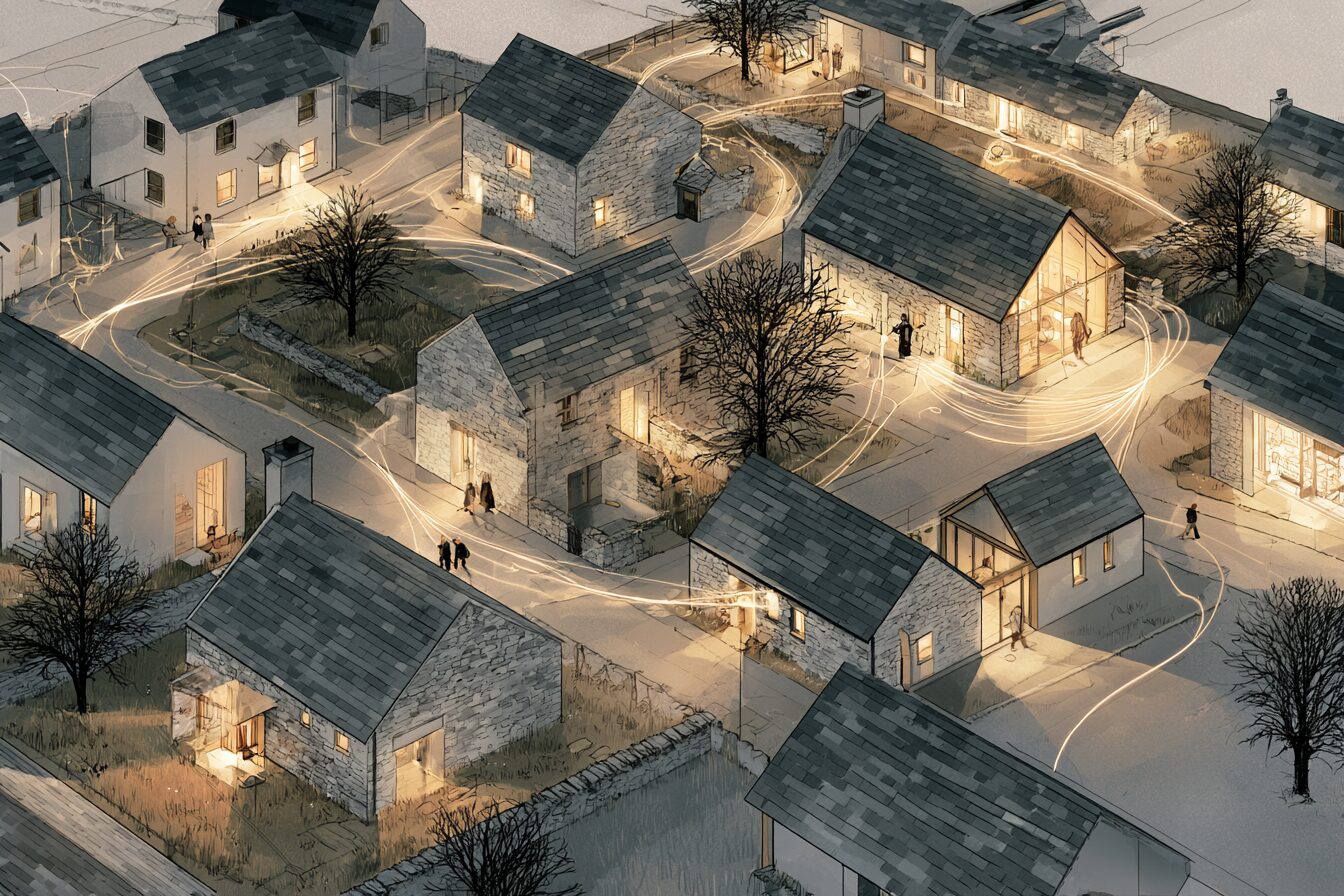
The challenge is not to solve everything at once. It is to begin. A practical pilot might bring together a local authority, a housing association, a community organisation and a further education college — and keep the ambition deliberately modest.
Five homes. A mix of starter, family and homes suitable for older residents. A local-timber-first approach. Modern methods where they fit. Apprenticeships embedded in delivery. Land held by a community trust. Long-term affordability built in. Digital tools supporting design, construction and maintenance. The aim would not simply be to create five homes. It would be to learn how a community might create five homes every year.
What could stop this
Honesty matters more than enthusiasm. Community-led housing is slow and hard to finance; trusts often run on thin volunteer capacity and can become dependent on the next grant. Land is difficult to assemble. A timber-first ambition meets a real gap — Wales grows softwood but has little construction-grade processing or panel manufacture, so today much engineered timber would still be imported, weakening the local-value argument until the supply chain is built. None of these is fatal. But a model that needs rescuing every cycle is not a capability — it is a sequence of projects wearing a capability's clothes. Naming that risk is the point: it tells us exactly what the pilot must prove.
The real asset
Perhaps the most important insight is that the greatest asset is not land, money or buildings. It is the ability of a community to organise itself around a shared purpose. Many places have underused land, local knowledge, practical skills and people who care deeply about where they live. What is often missing is a framework that lets these assets work together.
Housing can be that framework — not because houses solve every problem, but because housing sits at the intersection of so many others: skills, health, employment, energy, materials, finance, belonging. The future of housing may be less about building faster and more about rebuilding the capability of communities to shape their own future.
The houses are the visible result. The real achievement is a place that can keep producing them long after the first development is complete.
From the Studio — the wager behind this piece, and where it connects · sources & confidence
Stated as a wager we could be wrong about: that a community can build a standing capability to deliver about five affordable, local-timber homes a year. The test is not the first five homes — it is the second cycle. Signals of success over a three-year pilot: the run-rate holds without a fresh one-off rescue grant; apprentices complete and stay; a measurable share of build spend is retained in the county; and the homes remain affordability-locked on resale. The kill criterion is precise — if cycle two cannot be financed except by another bespoke grant, this was a project, not a capability, and the model has failed its central claim.
This piece sits with Farm in a Box, Letting the Water Back In and Battery Island because, like them, it is not really about its subject. The house is the lens through which we ask whether a community can still act collectively, keep value local, train its young people, support its older people, and shape its own future. It quietly overturns one assumption — that the housing crisis is a shortage of buildings — and replaces it with another: that it is a crisis of community capability. A natural follow-on, “The Community Builder”, would look at the new kind of local developer — part builder, part social entrepreneur, part cooperative organiser, part place-maker — that this implies.
Sources & confidence: UK imports ~80% of its wood (Forest Research, 2023) [A]; woodland ~15% of Wales, mostly lower-value softwood with construction-grade largely imported [A/B]; average Welsh home ~6× median earnings (ONS, 2025) [A]; Gwynedd second-home measures — council-tax premium, the 182-day rule, first Welsh Article 4 direction, 2024 [A/B]; Community Land Trust mechanism and Solva CLT / LILAC examples [A/B]; engineered-timber benefits stated directionally, not as fixed figures [B]; the Welsh sawmill product split is illustrative and dated [C]. Welsh community-led housing support: Communities Creating Homes (Cwmpas) [A/B].