An exploration
Proof of Work
Will we watch the machine, or will the machine watch us?
These explorations weave memory and present thinking — not records of what happened, but attempts to learn by holding the past and the present in the same frame. Why it reads this way →
In 2018, with a venture called verifyID, we tried to solve a genuinely awful problem with a slightly uncanny idea. The problem was on the front page of the Financial Times that March: at least a fifth of the cobalt exported from the Democratic Republic of Congo — one of the poorest countries on Earth — came from artisanal mines where child labour was common, and it was flowing, untraceable, into the batteries of the rich world. Inspection helped, but an inspector can only be in one place at one time. What happens when they leave?
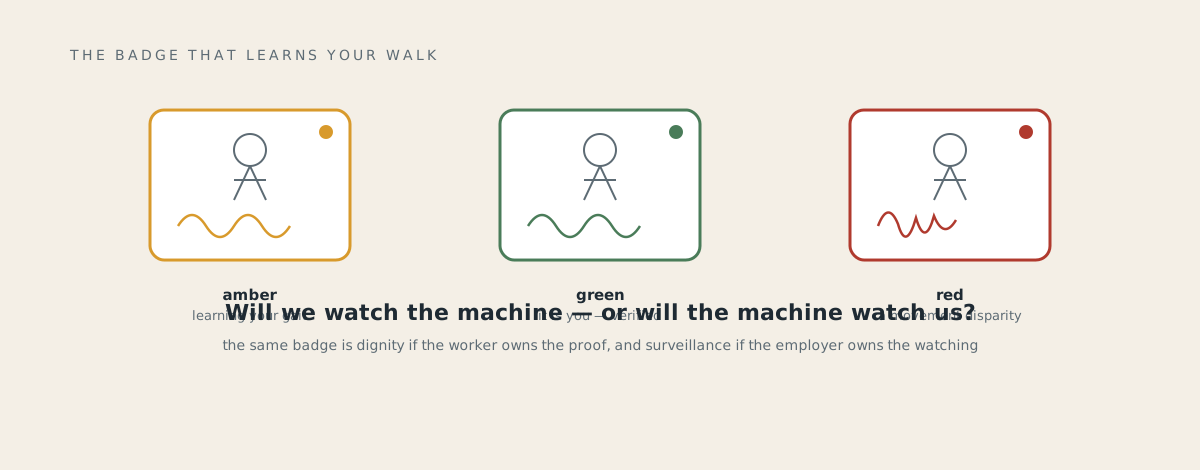
Our answer was a badge. It carried a small six-axis motion sensor, the same kind that sits in a fitness tracker, and it learned how its wearer walked — because the way each of us moves is, it turns out, individual: a movement thumbprint. Issue the badge to a verified adult worker; let it confirm, continuously and on-device, that the authorised person is the one actually working; let them attach proof-of-work tokens to what they produced; record those on a distributed ledger; and trace ethical labour all the way to the finished product. Tie it, finally, to pay — a direct link between work done and money earned.
It was, I can see now, a good idea pointed at a good problem. It was also the thing this whole notebook has spent a week circling, built eight years too early. The badge's gait check is a behavioural fingerprint. The proof-of-work token on a ledger is a reputation that accrues. The link to pay is payment-as-attestation. The piece I wrote a few hours ago — the fingerprints that touch us, about how a place might attest an AI agent without knowing its name — I had already built, in 2018, for a human being in a mine.
And, like its sister project Cashé, the wager has since been settled by law. The EU's Forced Labour Regulation — in force, with its trade ban landing in December 2027 — names cobalt, gold and tungsten explicitly, and will bar goods made with forced labour from the European market. The need verifyID described is now mandatory. Right, and early, again.
But look again at the badge
Now the uncanny part. Read those three states back, slowly. Amber, while it learns your gait. Green, once it is satisfied you are you. Red, when it detects a movement disparity. A device, worn on the body, that watches how you move all day, decides continuously whether you are behaving correctly, and is wired to your wages. Said plainly, that is not an ethical-sourcing tool. It is surveillance, sitting on the wrong side of the steepest power imbalance there is — between a person who needs the work and the company that grants it.
And it punishes the wrong people first. A gait changes with injury, with pregnancy, with age, with a long shift, with a borrowed pair of boots. A badge that flicks to red on a "disparity" and docks the pay behind it is not neutral; it is discriminatory by construction, hardest on exactly the bodies that already vary from the template. The mechanism I was proud of in 2018 is, looked at squarely, one firmware update away from a leash.
The hinge is who holds the proof
Here is the thing I missed then and want to hold onto now, because it is the whole argument. The same hardware points in two opposite directions depending on a single question: who owns the proof. Our own event deck, almost as an aside, had already found the better answer — "staff will permission use of their profile." Permission. If the worker holds the credential — a portable, self-owned proof of their skills and their genuine work, that they grant to an employer and can withdraw — then the badge is dignity: it is the worker's own reputation, carried between jobs, a defence against substitution and underpayment. If the employer holds the watching — continuous, mandatory, pay-linked — it is a productivity cage. Identical sensors. Opposite politics. Governance decides, not the technology.
Which means the interesting design question was never "how do we monitor them?" It was "how does a person come to own, and to grant, the proof of their own work?" That is reputation as provenance again — the move from the object that vouches for itself, and the place that vouches for itself — now turned to a worker who can vouch for themselves, on their own terms.
The gradient nobody consents to crossing
And this is where it stops being about badges, or even about work, and becomes the quiet thing I most want to keep working on. There is a gradient that runs underneath all of it, and almost nobody notices the moment they cross it. At one end: I have my data, and I permission it — granted, revocable, mine. At the other end: my data is demanded — the price of a service, or of a standard of care. The technology is identical at both ends. The only thing that changes is whether I can still refuse.
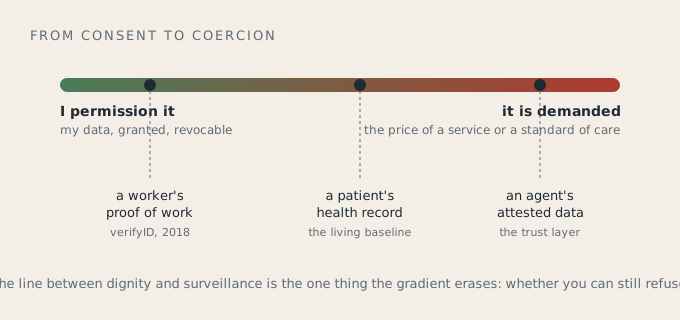
I feel this most sharply in the longitudinal health work — the living baseline, fourteen years of my own record held as something I steward and grant. Today that is empowerment: my data, representing my interest, the way a patient's agent should. But I can see the slope from here. When does holding your health record stop being a right you exercise and start being a condition of cover — or, worse, of the standard of care you are offered? A worker permissions their gait; then a job requires it. A patient permissions their record; then an insurer assumes it, and the person who declines is treated as if they have something to hide. The badge, the bag, the health record and the agent are the same diagram — and so is the trap. Consent is a real thing exactly until it becomes the toll on a road you have no other way to travel.
A line to hold, not a problem solved
I am leaving this piece deliberately unfinished, because it is not finished — in 2018, in 2026, or in the years just ahead, when the watching gets cheaper and the demanding gets more polite. The proposition is not a product. It is a line. Build the worker-owned, consent-based, revocable form of every one of these proofs, and treat the drift toward demanded as the failure mode to design against, name in the open, and refuse where we can. The question on the badge is the question for all of it. Will we watch the machine, or will the machine watch us — and, the part that decides everything, who is allowed to look away?
From the Studio — the wager behind this piece, and where it connects · sources & confidence
From the Studio — a working piece, and where it connects. verifyID (2018) is the human ancestor of the-fingerprints-that-touch-us: gait as behavioural fingerprint, proof-of-work tokens as accruing reputation, the link to pay as payment attestation. It is the worker half of the same 2018 move whose object half is Cashé / The Object That Vouches for Itself — and both have since been vindicated by EU law (the Digital Product Passport for objects; the Forced Labour Regulation for work). The conjecture under it: the durable, defensible form is a worker-owned, consent-based, identity-light credential, not an employer-owned continuous watch. The defeater is not a side-note but the spine — continuous gait monitoring tied to pay is surveillance, discriminatory against bodies that vary, and it sits on a consent-to-coercion gradient that also runs through the living baseline: my health data, permissioned today, demanded tomorrow as the price of care. Kill the dignified version's claim if in practice it only works employer-owned and continuous. This piece is left open on purpose; it is one to keep working.
Sources & confidence: verifyID (With a W, 2018) — the author's own venture decks, Proof of Work and Events [B]; the cobalt / artisanal-mining / child-labour framing (FT, 28 March 2018) as cited in the deck [B]; gait recognition and behavioural biometrics as continuous authentication — a real, maturing field [A/B]; the EU Forced Labour Regulation (Regulation (EU) 2024/3015), in force 13 December 2024, prohibition applying 14 December 2027, covering minerals including cobalt, gold and tungsten, with implementation guidelines due 14 June 2026 [A]; the Corporate Sustainability Due Diligence Directive (CSDDD), in force July 2024, phasing 2028–2030 [A]. The through-line to reputation-as-provenance, the agent-trust cluster and the consent-to-coercion gradient (including the link to the-living-baseline) is the author's own, graded in the Stiwdio reasoning graph.