An exploration
The Landscape Remembers
Mythology as a living reasoning system
These explorations weave memory and present thinking — not records of what happened, but attempts to learn by holding the past and the present in the same frame. Why it reads this way →
Long before I had any words for it, I had the Larousse Encyclopedia of Mythology. It was published the year I was born; our copy was a worn paperback from the mid-sixties, with an introduction by Robert Graves, and it still sits in my library. As a boy in North Wales I would turn its pages for the stories and the strange, beautiful illustrations — gods and giants and winged bulls from a dozen cultures I could not have found on a map. I understood none of the scholarship. But something lodged: the characters looked completely different and kept telling the same few stories. Different faces, the same tale.
That small observation never left me, and I think it has quietly shaped everything I have done since. The projects look nothing alike — a valley in Jordan, an island in the Irish Sea, a market town in Wales, a canal, a battery, a field held in common. Different places, different people, different briefs. Yet the approach beneath them has always been the same: recognise and celebrate the differences, and be rigorous in the response. My projects are my stories.
For years that was only a private habit of mind. Now, at last, the tools exist to discover and codify it. What began as a question — how might you interrogate the structure of AI from the side of the stories we tell ourselves? — became a quest to understand how I work, and has ended up as a reasoning graph that sits behind these very essays and helps me write them. So let me begin where it began for me: with a story attached to a place.
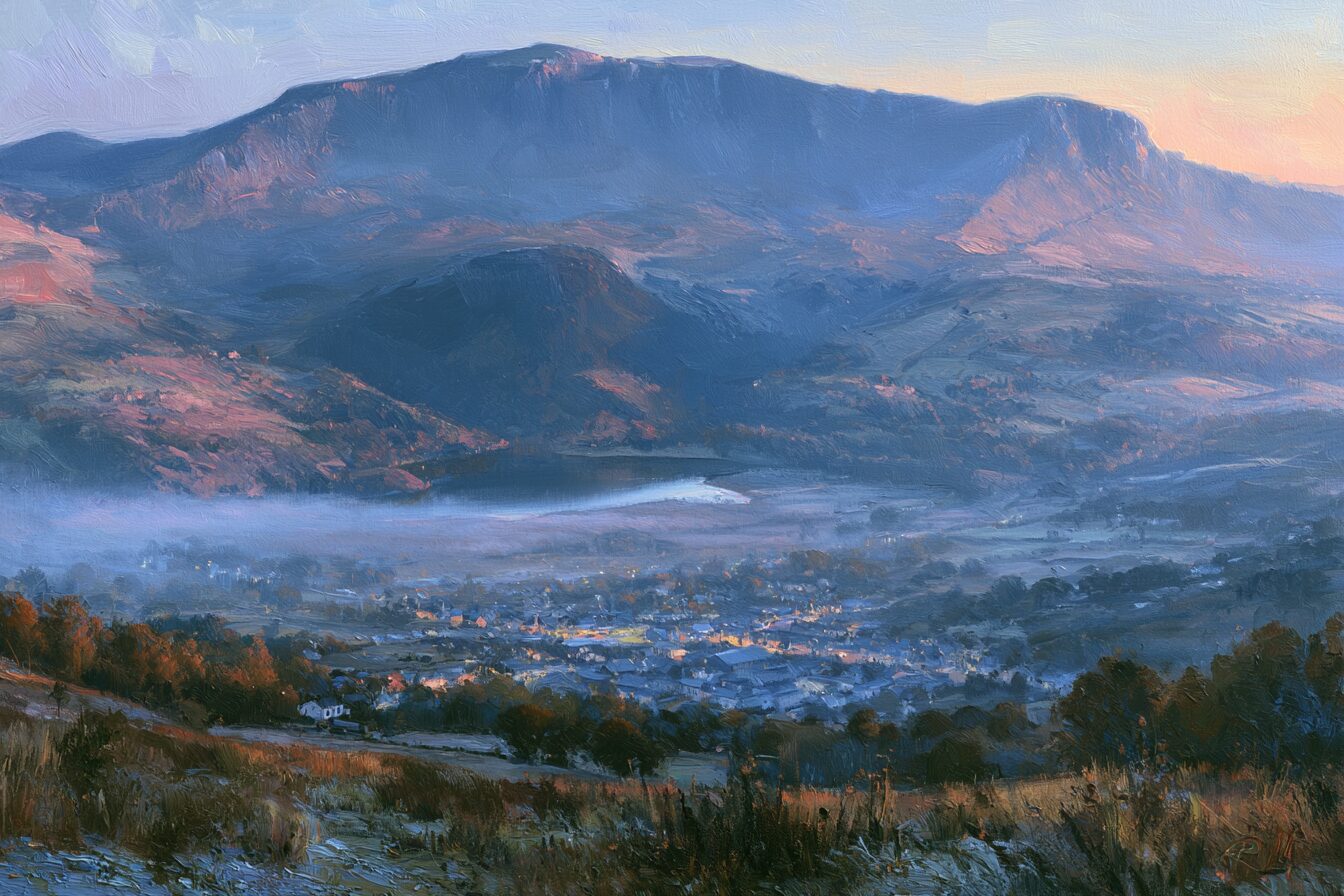
There is a mountain above Dolgellau that has been gathering stories for longer than anyone can remember. It is called Cadair Idris, and it appears in maps, paintings, poems and brochures — yet none of those is quite the thing itself. The mountain is also a story. Not a single story, but a collection layered one upon another over centuries.
The name means the Chair of Idris. Idris was a giant — in the old Welsh Triads an astronomer who sat on the summit to study the stars — though tradition long ago blurred him together with a real prince of Meirionnydd who lived around the seventh century. The giant is legend; the prince was real; the story keeps both and is not troubled by the difference. Its most famous tale — that a night alone on the mountain leaves you a poet, a madman, or dead — feels ancient, but it is first written down around 1600, and was carried to the world by Romantic poets two centuries after that.
That last detail is worth pausing on, because it undoes a comfortable assumption. The legend is younger than it feels. The mountain was still gathering stories in 1600, and it has not stopped since. The details vary with the teller. The meaning shifts with the age. Characters appear and disappear. And yet the story remains recognisably itself.
For a long time this seemed entirely normal. Then computers arrived, and it began to seem strange. Computers were meant to be precise; stories were vague. Computers dealt in facts; stories in meaning. The emergence of artificial intelligence is quietly dissolving that distinction.
The more we try to build machines that understand the world, the less the world looks like a list of facts — and the more it looks like a mythology.
Stories as knowledge infrastructure
Modern AI increasingly leans on structures called knowledge graphs. A knowledge graph does not store isolated facts; it stores relationships — entities and the typed connections between them. A mountain holds a lake. A lake feeds a river. A river reaches a town. A town remembers an event. An event shaped a person. Meaning lives in the connections, and the whole grows richer as more are added.
The resemblance to mythology is hard to miss. Mythic stories rarely stand alone: characters connect to places, places to events, events to lessons, lessons to ritual, ritual to identity, identity to community. In the Four Branches of the Mabinogi the same figures return in changing roles — Pryderi runs through all four, alongside Rhiannon, Gwydion, Math, Lleu — and the tellings cheerfully disagree with one another. The national park's own guide to Idris puts it better than I can: there are different versions of every legend, and all versions are true.
To be clear, this is a resemblance, not an identity. A knowledge graph is formal and rule-bound; a mythology is contradictory and human-read. But the likeness is real, and it carries a lesson our institutions tend to forget. We assume that preserving knowledge means freezing it. Mythology shows the opposite: the structure survives precisely because the stories are allowed to change. The variation is not a fault in the system. It is how the system learns.
Ambiguity is not failure
One of the hardest problems in AI is ambiguity. People imply, exaggerate, joke, contradict themselves, change their minds; meaning often sits in the spaces between words. Traditional computing struggles with this. Mythology does not — there, ambiguity is a feature. The giant Idris may be a person, a king, a giant, or a memory of a leader dissolved into landscape. All of those can be true at once, and the story still works, because its job was never to prove which reading is correct. Its job was to help people navigate uncertainty.
Modern reasoning systems are arriving at the same place. The most useful answer is often not the most certain one; it is the answer that acknowledges complexity while still allowing action. That is exactly what stories have always done — provided enough structure to decide without demanding perfect information. In a century of climate change, economic disruption and technological acceleration, the ability to act well under uncertainty may be the most valuable thing a community owns.
The story beneath the story
Myths also repeat. The names change, the settings change, the pattern stays. A hero crosses a threshold. A gift becomes a curse. Power is gained and misused. A bargain is struck, a sacrifice required, a balance restored. These patterns recur across cultures and centuries, and they act almost like reusable reasoning frameworks: when a community meets something new, it reaches for an old shape to make sense of it. That is not superstition. It is efficient.
Which raises a genuine question. Could AI systems learn not only from historical data but from historical narrative structures — not because old stories predict the future, but because they encode recurring human behaviour? Artificial intelligence itself is most easily understood through exactly these old shapes: the gift that grants power but demands wisdom, the tool that amplifies both virtue and folly, the creation that takes after its maker. The technology is new. The pattern is very old.
A global audience, a single home
There is one more property of mythology that matters here, and it is economic. Stories travel; landscapes do not. A myth can be retold in every country on Earth while the mountain that bears it stays exactly where it has always been. There is only one Cadair Idris — one valley where this particular weave of people, weather, geology and memory produced this particular tradition.
For rural places, that asymmetry is an opportunity rather than a loss. So much economic life detached itself from geography — production moved, supply chains stretched, value leaked away, and digital technology only sped it up. Mythology runs the other way: the audience can be global while the source stays stubbornly local. The walking economy showed how a story can be global and its source local; here that becomes a foundation to build on. The question stops being how to attract visitors and becomes how to build meaningful relationships between a global audience and a single landscape — so that communities remain the authors of their stories, not merely the attractions in them.
Whispers of Idris
This is the ground the work I am calling Whispers of Idris is trying to explore. Rather than treating mythology as a fixed archive, it treats it as a living system: stories become connected nodes, characters become relationships, places become anchors, themes become patterns. The mythology can be explored, analysed and extended while staying rooted in the landscape that made it. Artificial intelligence becomes a tool for navigation, not replacement — the machine reveals connections; the community keeps ownership of meaning. New stories can join. Old ones can be reread. The system stays alive.
And the mountain is not a backdrop to it. It is part of the reasoning system itself — the anchor that keeps the narrative world tied to the physical one. That connection may turn out to be the most valuable part of the whole approach.
It has already begun
This is not only theory. We have already run a small version of it. In a film school we set up in Dolgellau, local children were told part of the tale of Idris and introduced to its characters, then spent a week writing their own story and turning it into a film. A community told a new part of an old tale. The young people did not merely learn the mythology embedded in the hills around them — they added to it.
That week answered some of my doubts and sharpened the others. It showed the thing that matters most: a community can be the author rather than the attraction, and adding to a tradition is precisely how a living mythology has always renewed itself. What it did not test — because there was no machine in the room — is the harder half: whether the tool, when it arrives to help hold and extend the story, can keep faith with provenance. The children's new story is itself the test case. Recorded well, it joins the graph clearly marked as new, theirs, of this decade — a fresh node beside the old ones, not blurred into them. Recorded badly, it would be indistinguishable from something centuries old, and that blurring is the single failure the whole approach exists to prevent.
What could stop this
The danger is specific, and it is the mirror image of the promise. A generative model's instinct is to produce fluent, plausible, unsourced text — the precise opposite of provenance. Point such a system at a mythology and it will happily invent new legends that never existed and present them with the same confidence as the oldest attested tale. That would not enrich the tradition; it would dissolve it, because what makes a living mythology trustworthy is that a community can still tell which threads are old and which are new.
Welsh tradition itself carries the warning. The familiar druidic symbol of awen — the three falling rays — and much of the 'ancient' apparatus around it were invented around 1800 by one brilliant forger, Iolo Morganwg, and passed for a long time as antiquity. A mythology engine with no sense of provenance would manufacture Iolo Morganwgs at industrial scale. The safeguard is the discipline this notebook already runs on: every node carries a grade and a link to its source — attested text, community oral history, or machine suggestion clearly marked as such — and nothing invented is ever allowed to wear the clothes of the attested.
Two further cautions sit alongside it. There is the risk of commodification — of a living culture flattened into a theme park, a community turned from author into attraction, its meaning sold off without consent. And there is the simple temptation to overclaim: mythology resembles a reasoning system; it is not literally one, and the work is worth more if it resists its own metaphor.
What we can do now
The useful question is not whether mythology matters. It is what can actually be built — and the honest answer is that all of it can begin now, small enough to prototype. A community-owned mythology graph connecting stories, places, archives and oral histories. Educational tools that let young people walk a real landscape through its narrative network. AI used to surface recurring patterns across old stories and present problems. Location-based storytelling rooted in actual places. Pathways for local writers, artists, filmmakers and technologists to add new stories to the existing weave. And, underneath all of it, a governance model that keeps the cultural assets locally stewarded.
The landscape thinks through us
Perhaps mythology is not only a record of how people once understood the world, but a mechanism through which communities understand it still. Stories let knowledge survive uncertainty. They permit adaptation without forgetting. They connect generations who never meet. They hold continuity while allowing change. Artificial intelligence is presented as something wholly new, and in one sense it is — but in another it is the latest attempt at a very old problem: how to make sense of a world larger and more uncertain than any one mind can hold. For thousands of years we answered that with stories. Now we are starting to answer it with machines. The most resilient future probably comes not from choosing between them, but from seeing how deeply they resemble one another.
The landscape remembers. The stories evolve. And if we listen carefully, they still have something to teach us about the futures we are trying to build.
From the Studio — the wager behind this piece, and where it connects · sources & confidence
An honesty this notebook owes itself: the reasoning graph beneath these very essays — typed, sourced, fact-checked, confidence-graded relationships between pieces — is a small working prototype of exactly what Whispers of Idris proposes for mythology. This piece is not describing a future technology from the outside. It is describing, from the inside, the thing the notebook is already built on. The earliest essays were its training feed; as the body of work grew, so did the tool's reach and rigour. This piece is being written with the help of the very thing it describes, in its earliest form.
The wager, now partly tested. The Dolgellau film school already proved the first leg: a community will author new story, and that authorship renews a tradition rather than cheapening it. Two legs remain open. First, provenance under the machine — as the graph grows, every node must carry a grade and a link (attested text, community oral history, or machine suggestion plainly marked as such), and no machine-made story may ever pass as tradition; kill the design if it does. Second, community benefit in the economic sense — at least one educational, tourism or creative product that pays back locally and keeps the community as author, not attraction (the subject of the companion piece). The disconfirming risk is built into the tool: generative AI runs against provenance by nature, so the whole design must work against its own grain.
A companion piece will follow this one. Where The Landscape Remembers treats mythology as a reasoning system, the next will treat it as economic infrastructure: how a globally consumed story world can create local employment, education, tourism, digital products, creative industries and stewardship — while remaining authentically rooted in a single landscape. It is the turn from insight to action this notebook always tries to make, and it points, with The Cooperative Table, toward agentic tourism and the wider Awen Weave.
Sources & confidence: 'Cadair Idris' = Chair of Idris [A]; Idris Gawr the giant/astronomer (Welsh Triads), conflated by tradition with the historical prince Idris ap Gwyddno of Meirionnydd — the giant is legend, only the prince historical [B; D for the giant's historicity]; the 'poet, madman or dead' sleep legend attested from c.1600 (Siôn Dafydd Rhys), printed 1802, popularised by Felicia Hemans 1822 — early-modern, not ancient [B]; awen as medieval Welsh poetic inspiration [A], but the /|\ druidic symbol and apparatus invented by Iolo Morganwg c.1800 [A]; the Mabinogi's recurring figures and coexisting variants, 'all versions are true' (Eryri National Park) [A]; knowledge graphs store entities + typed relations for reasoning [A] — the mythology resemblance is an analogy, not an identity. The Larousse Encyclopedia of Mythology (Hamlyn English edition, introduction by Robert Graves) and the Dolgellau film school are the author's own — book and first-hand account [A]. Whispers of Idris is the author's own emerging project.