An exploration
The Object That Vouches for Itself
Eight years of one idea — from a luxury handbag to an AI agent
These explorations weave memory and present thinking — not records of what happened, but attempts to learn by holding the past and the present in the same frame. Why it reads this way →
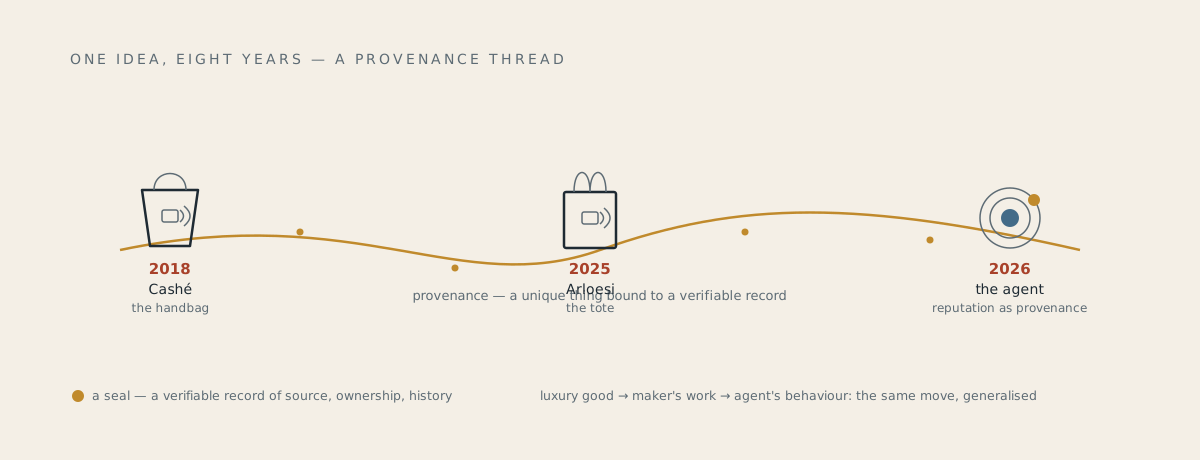
In 2018, with Future Planet Capital and the leather-goods maker Tusting, we built a thing called Cashé. The pitch was simple and, at the time, slightly mad: embed a tiny NFC chip in a handbag at the point of manufacture, and bind it to a tamper-proof record of where it came from, who made it, and who owns it now. Tap the bag, prove it is genuine. Pass the record to the buyer at the till. Counterfeiting solved at the object, not the border. On top of the ownership token you could then layer services — insurance, lending against the bag as collateral, resale and rental. It was aimed at markets where trust carries a premium, which in 2018 meant Far-Eastern luxury.
It looked, to most people I described it to, like crypto hype dressed up as luggage.
Eight years later it is neither hype nor luggage. It is law — and a forty-million-product industry that someone else built.
The wager, settled
LVMH, Prada, Cartier and OTB formed the Aura Blockchain Consortium and did exactly what Cashé described: NFC-chipped digital certificates of authenticity for luxury goods. Aura has now passed forty million encrypted products; OTB alone has put around three million Marni, Margiela and Jil Sander pieces on it. And the European Union, through its Digital Product Passport, is about to make a version of this mandatory — every textile good carrying a QR or NFC tag that opens onto its provenance, phasing in across 2026 and 2027. The idea was right. It was also early by the better part of a decade.
There is a sting in that, and the honest thing is to name it. Being first is not the same as capturing the value. We built a demonstrator; the luxury houses, with their consortia and their scale, built the industry. That is the oldest lesson in this notebook — the market that closed — wearing a new coat: an idea can be correct and still be carried off by whoever owns the route to it.
The same move, brought home
The idea did not stay in luxury. Last year it came back to Dolgellau. At Arloesi we ran an evening lecture — “What’s in Your Bag?” — around a much humbler object: a tote bag with a unique backstory, a digital twin minted online, an NFC chip you tap to read its story, prove you own it, unlock what the maker chose to share. The same mechanism as Cashé, scaled all the way down from a Far-Eastern luxury market to a maker in a market town. Not provenance as a defence against counterfeiting, but provenance as a way for a small maker to keep hold of the story, and the relationship, that usually leaks away the moment a thing is sold.
What was actually durable
Here is the part worth keeping, because it is the part that survived. The durable idea was never “blockchain,” and it was certainly never “NFT.” When the speculative NFT market collapsed in 2022, it took the word down with it, and the 2025 lecture’s framing — mint an NFT, use this platform — is the weakest thread to pull, because it ties a sound idea to a tainted one. Strip the speculation away and what is left is the thing that was always doing the work: verifiable provenance. A unique object, bound to a record you can check, that says where it came from and who holds it. That is what the Digital Product Passport standardises, and it reaches it through verifiable credentials, not crypto tokens.
Which is why this is not really an essay about handbags either. The move — bind a unique entity to a graded, verifiable record — is exactly the move the rest of this notebook has been making about other things entirely. A place that can vouch for itself binds a claim about itself to a provenance grade and a freshness date. An AI agent earns a reputation by binding its genuine transactions to identity-free, verifiable stamps. Reputation as provenance is object provenance, generalised from things to behaviour. The handbag, the tote and the agent are the same diagram.
Where the value could still sit
So the open question is not whether object provenance matters — the regulators and the luxury houses have answered that. It is who owns the layer. Aura concentrated it among the majors. The Digital Product Passport risks turning it into compliance, a box tapped once and never again. The narrow, ownable thing left — the Arloesi-shaped thing — is maker-controlled provenance: a place holding the provenance layer for its makers, so that the record, and the relationship with the buyer, stay with the person who made the object rather than with a platform or a compliance vendor. The object that vouches for itself, the way a valley can vouch for itself.
We were eight years early, and someone else banked it. The second time the idea comes round, the thing worth keeping is not the patent. It is who gets to hold the record.
From the Studio — the wager behind this piece, and where it connects · sources & confidence
From the Studio — the wager, and where it connects. This piece is the notebook’s own method turned on the author: an idea that originated in a 2018 venture (Cashé), reappeared in a 2025 community lecture (Arloesi), and matured into the 2026 trust theses — dormant, not obsolete. The conjecture under it: the enduring, ownable layer is maker-controlled verifiable provenance, and a place can hold it for its makers rather than ceding it to a luxury platform or a compliance vendor. Pre-registered test: an Arloesi maker pilot — one-off pieces with a secure NFC bind to a maker-controlled, DPP-aligned record; measure whether buyers verify it and whether the maker keeps the warranty/resale/story relationship a platform would otherwise own. Kill if buyers don’t verify, if makers can’t hold the layer without a platform, or if the rail is a natural monopoly that leaves no local value. The honest disconfirming risk is the 2018 one, repeated: right idea, value captured by whoever owns the route to market.
Sources & confidence: Cashé (With a W / Future Planet Capital / Tusting, 2018) — the author’s own project document [B]; the Arloesi “What’s in Your Bag?” lecture (2025) — the author’s own deck [B]; the Objct minting platform named in the deck [C, unverified]; EU Digital Product Passport (ESPR) mandating NFC/QR provenance for textiles, phasing 2026–2027 [A]; Aura Blockchain Consortium (LVMH, OTB, Prada, Cartier) — NFC certificates of authenticity, 40M+ products encrypted, ~3M across OTB brands [A]; Arianee Digital Product Passports for Lacoste and Mugler [A/B]; the speculative NFT market collapse of 2022 [A]. The through-line to reputation-as-provenance and the agent-trust cluster is the author’s own, graded in the Stiwdio reasoning graph.