An exploration
The Saline Economy
Why fight the salt?
These explorations weave memory and present thinking — not records of what happened, but attempts to learn by holding the past and the present in the same frame. Why it reads this way →
There is a reflex, when faced with salt water, to remove the salt. Desalination. Spend energy, push the water through membranes, take the salt out, and throw the brine away — usually back into a sea that is already too salty. We treat the salt as the problem to be solved.
But why fight the salt? Why not build an economy that wants it?
That was the question behind the Saline Economy. Instead of spending energy to make salt water behave like fresh water, find the uses that prefer it salty — the saline-tolerant and the saline-dependent — and connect them into a system where the salt is the medium, not the enemy.
A circular economy
It begins with agriculture that does not mind salt. Saline-tolerant crops, and managed systems that wash the salts out in stages, reducing salinity step by step until the water can feed hydroponic growing. Nothing is wasted by being too salty; it is simply matched to the stage that suits it.
Then the loop closes, and this is where it becomes interesting. Salt water feeds fish. Algae grown in salt water becomes a food supplement and a feed. The water that carries the effluent from the fish is cleaned by the algae, which captures the nutrients — and the residual algae biomass, returned to the land, becomes organic matter that enriches the desert itself.
Each stage takes what the previous stage discarded. The waste of one process is the feedstock of the next. The salt that made the water useless for a wheat field is exactly what makes the whole loop turn.
The backbone
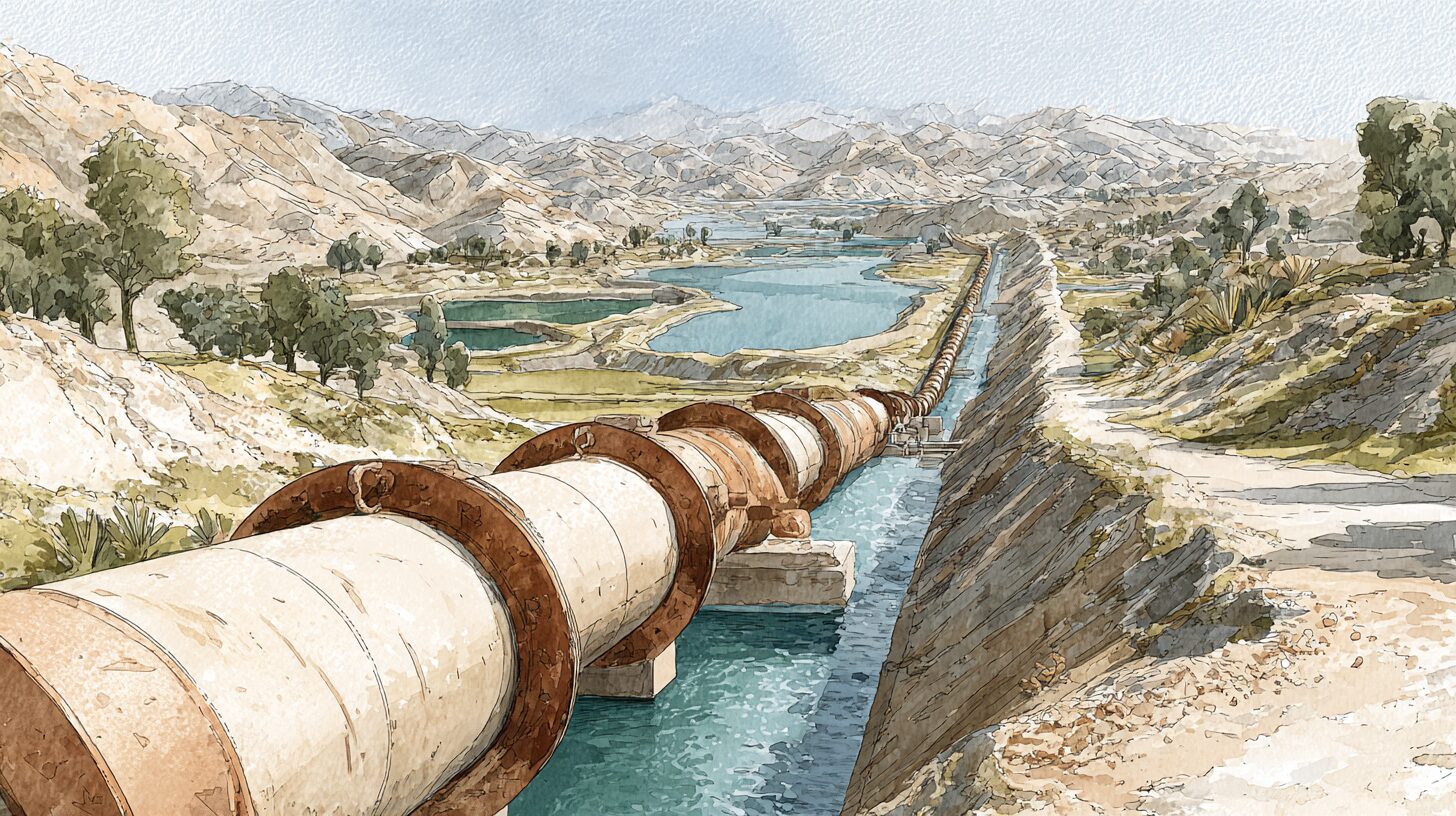
What made it conceivable at scale was a project that was live at the time: the Red–Dead conveyance, carrying water from the Gulf of Aqaba up and across to replenish the shrinking Dead Sea. An enormous flow of sea water moving through the country.
If that much salt water was going to move anyway, it could underpin an economy on its journey — the same instinct as borrowing the water, but at national scale. The conveyance was not just a way to save a dying sea. It was a potential bloodstream for a saline economy built along its length.
Old roots
The thinking was not new, and we did not pretend it was. The algae work drew on the experiments in Hawaii from the Carter era, when energy from algae first looked serious. And it drew on ideas that had circulated around the Clinton-era peace between Rabin and King Hussein — a moment when water, of all things, was understood as something that might be shared rather than fought over. The Saline Economy was a way of gathering those threads and giving them somewhere to go.
The innovation was a name
The innovation was not a technology. It was a name.
Here is the part I find most interesting in hindsight. The most important thing the Saline Economy did was not technical. It was to give a scattered set of ideas an identity. A name. A brand.
Saline-tolerant agriculture, algae biotech, brine chemistry, desert restoration, fish systems — these existed in separate corners of separate departments. By naming the Saline Economy, and imagining a Saline City where a research centre fed spin-off industries which fed a whole economic zone, we gave the field a shape that scientists could see themselves in. Something to belong to. Something to put on a door.
This is a quieter kind of infrastructure than a canal or a power line, but it may be the most powerful kind. Academia does not move towards a problem. It moves towards an opportunity with a name and an identity. Brand the opportunity, and the capability gathers around it.
What remains
The desalination reflex is still with us, and it is sometimes the right answer. But the deeper idea has only grown more relevant: a region defined by its scarcity of fresh water might do better to build on the abundance it actually has — salt, sun, and sea water on the move — than to spend its energy pretending to be somewhere wetter.
The hardest infrastructure to build is not a pipe or a pump. It is a name worth gathering around — and once a field has one, the people come.
From the Studio — sources & confidence
With thanks to Akram Abu Hamdan, who brought the Valley of Opportunity to us from the Royal Court, and The Urban Foundation. The 2008 masterplan was developed with Foster + Partners; the algae thinking began with Chris Glasow.