An exploration
The Valley That Can Vouch for Itself
On agentic tourism, and the question of who keeps a place's knowledge true
These explorations weave memory and present thinking — not records of what happened, but attempts to learn by holding the past and the present in the same frame. Why it reads this way →
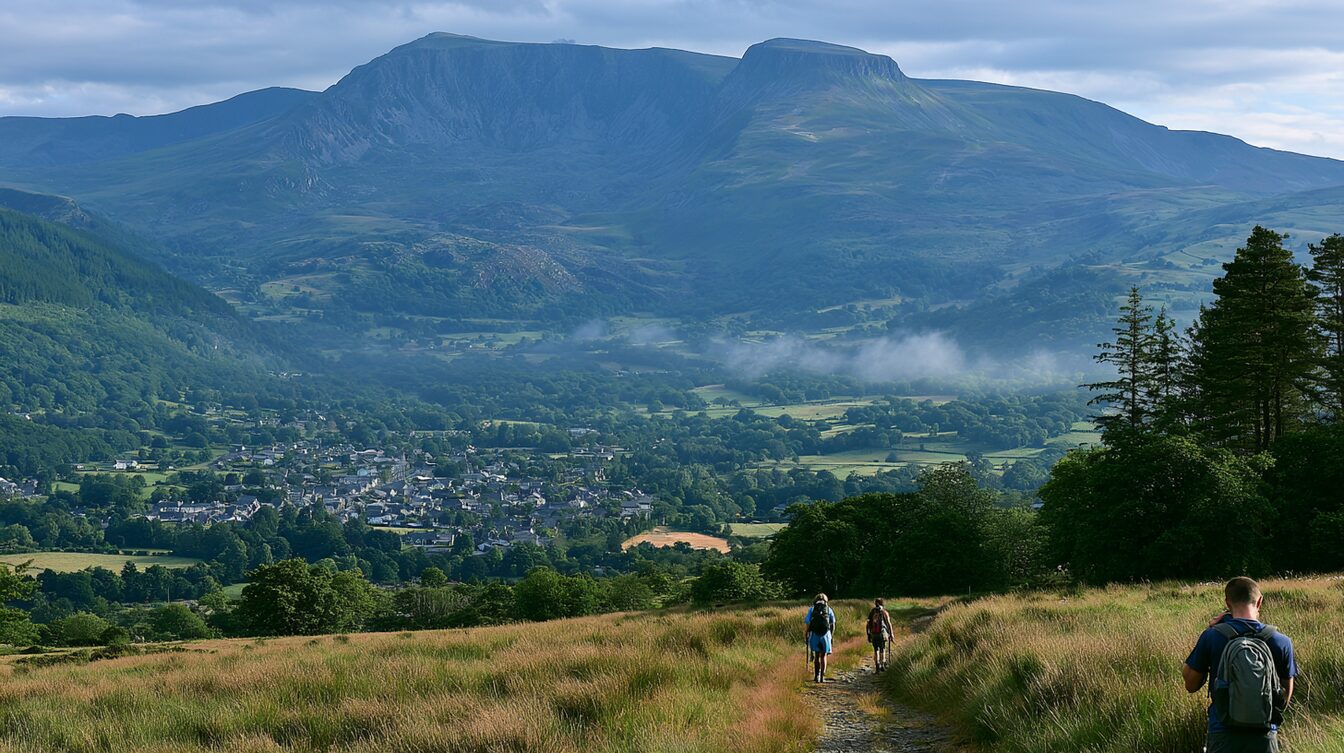
Stand at the foot of Cadair Idris on a bright Saturday in June and you will see two kinds of visitor. The first has a paper map, a flask, and a vague memory of a walk done twenty years ago. The second has a phone, and on that phone an assistant that has already planned the day — the route up the Minffordd path, a table booked in town for one o'clock, the weather, the parking, the advice to allow three hours for the ascent.
The second visitor is new. Not the phone — we have had phones on the mountain for years — but the assistant. Increasingly, people are not searching the web and deciding for themselves. They are asking something to decide for them, and then doing what it says. The trip is planned by software that talks back, books things, and acts on the traveller's behalf. This is what the industry has started calling agentic tourism, and whatever you make of it, it is arriving whether or not any particular valley is ready.
Here is the small, sharp problem that started this notebook. The assistant that planned the perfect day on Cadair Idris is confident, fluent, and often wrong in a very particular way. It knows a great deal about the mountain — the height, the history, the legend that whoever sleeps on the summit wakes a poet or a madman — but it cannot tell you whether the upper path is closed this week for erosion repair, whether the car park filled by half past nine, or whether the café it recommended shut last autumn. It knows information. It cannot vouch for anything.
That gap — between knowing about a place and being able to vouch for it — is the interesting one. It is not really a tourism problem. It is a question about who holds a place's living knowledge, who keeps it true, and who benefits when it is trusted.
The first question: can a place vouch for itself?
The assistants are not going away, and the honest thing to notice is that they are not the enemy. They are simply incomplete. They are built to be plausible, and plausibility is not currency. The path was open when the model was trained; the path is closed today; the model does not know the difference, and has no way to find out.
What it lacks is a source it can ask — one that answers not "here is what I have read about this place" but "here is what is true about this place right now, here is who says so, and here is when they last checked." That is a different kind of answer. It carries provenance. It carries a freshness date. It is the difference between a rumour and a vouching.
And the source of such answers cannot plausibly be a model in California. It has to be local. Only people who are actually here — the warden who knows the path is shut, the café owner who knows the new hours, the volunteer who walked the trail on Tuesday — can keep that knowledge current. The global assistant is structurally unable to generate local truth. It can only relay it, if someone trustworthy will provide it.
A vouch is not a single answer but a standing relationship. The moment a place can be asked, it can also be subscribed to.
This is the half of the value that agentic technology makes newly possible. When the assistant asks "is the Minffordd path open?", the question can leave a trace: who asked, on whose behalf, and — if they choose — a standing trigger to be told if the answer changes. So when the warden closes the path on Tuesday morning, the update does not sit on a website hoping to be found. It pushes, straight to the handful of agents that asked this week, and through them to the people already lacing their boots. The stale, confident, slightly-wrong answer is not corrected after the fact; it is overtaken before it can do harm. That, incidentally, is the honest answer to the liability of vouching: you are not promising the path will never close — you are promising that when it does, the people who need to know will be the first to.
And the trace runs both ways, which is what turns the authenticator's side from a vague duty into a rigorous one. Because the place can see what is being asked, it knows exactly what is worth keeping current — which footpath, which car park, which week. The warden is no longer publishing into a void; they are answering live, specific, accountable questions, and so they know precisely what to report, to whom, and when. Demand shapes the record. The questions a place is actually asked become the list of things it has agreed to vouch for — and knowing who is waiting on an answer is itself what keeps the answer true.
So the first thing agentic tourism makes newly valuable is something a community already has and has never been able to sell: the ability to say, with authority, this is still true, and we are the ones who know. Not the data itself — the fact of a footpath wants to be open, free, shared. What is scarce is the vouching: the verified, current, accountable answer. A place that can vouch for itself becomes the thing every confident-but-uncertain assistant needs and cannot build for itself.
This reframes the anxious conversation about technology arriving in rural places. The usual fear is that the big platforms will know everything and the small place will be reduced to a line in their catalogue. But the platforms do not know the things that matter most on a wet Tuesday in Gwynedd. The local knowledge is the moat, not the vulnerability — provided the community decides to hold it deliberately rather than let it leak away unrecorded.
The second question: can a visit leave a place better, and can we count it?
The second question grows out of a discomfort anyone who lives in a beautiful place will recognise. Tourism, as currently measured, counts the wrong things. It counts footfall and spend — how many people came, how much they paid. It does not count what they left behind, for good or ill: the eroded path, the full bin, the disturbed nesting site — but also, and this is the part we have almost no language for, the contribution.
Because some visitors do leave a place better. People already come to repair paths, plant trees, pull invasive species, count birds, survey habitats. Conservation holidays and volunteering days are not new. What is new is the possibility of measuring that contribution as seriously as we measure spend — of giving a place a running account not just of what visitors took out, but of what they put back.
Imagine a simple, honest figure for a valley: its net visitor contribution. Not a slogan, but a real measure — metres of path restored, trees in the ground, biodiversity records logged, hours of skilled stewardship given — set against the wear of the season. Most places, measured honestly, would start in deficit. That is not a reason to hide the number. It is a reason to have it, because a number you can see is a number you can move.
Here the two questions join. A contribution only counts if it can be verified — if "thirty metres of path restored on the Pony Path, drystone, to standard, on the 14th of June" is an attested fact and not a feel-good claim. The same capacity to vouch that the assistants need for footpaths is exactly the capacity needed to make contribution real. Once a place can verify what is true about itself, it can verify what was done to it, and by whom.
This matters beyond tourism, and in a way that has suddenly become concrete. Organisations are under growing, and increasingly legal, pressure to show genuine, independently substantiated evidence of environmental and social action rather than vague green claims. A company that brings a team to spend a day restoring a path on Cadair Idris, and walks away with a verified, provenance-backed record of exactly what was contributed, has something newly worth having: proof of action, not a logo on a brochure. The community gets the labour and the restored land; the visitor gets the verified record. Nobody had to sell the community's data to make that exchange work — what was exchanged was the vouching for the deed.
This is where vouching turns into something a community can own outright: a certification. That verified contribution record is precisely the independently-substantiated evidence the new rules now demand, and the place that builds the standard first — what counts as "thirty metres restored, to standard", who is trusted to attest it, how it is recorded and kept — owns that standard. Certification accrues to whoever creates it credibly first; it is one of the few advantages that genuinely compounds, because every later user has to come to the authority that already exists rather than build a rival one. A valley that becomes the trusted certifier of real environmental action on its own ground is not renting out its scenery. It is issuing a credential the wider world increasingly cannot do without — and keeping the authority to issue it at home.
Modest and real beats grand and unprovable. A path-repair morning is not a planetary intervention — but almost nobody currently measures whether corporate volunteering achieves anything at all, and a verified record of real, local, modest good fills a gap that is genuinely empty.
The third question: can the value stay in the valley?
The third question is the oldest and the most political, and a community feels it in the stomach. When a visitor books a room through a global platform, a slice of that money leaves the valley and never comes back. When they eat, sleep and buy through intermediaries headquartered elsewhere, the place becomes a backdrop for an economy run from somewhere else. The scenery is local; the margin is not.
Agentic tourism could make this worse. If the assistant routes every booking through the same handful of global services, the disintermediation deepens — now even the choosing happens elsewhere, optimised for the platform's margin rather than the place's resilience. The lesser-known maker, the independent guide, the farm doing something interesting with rare-breed wool become invisible to a system that surfaces only what pays to be surfaced.
But the same technology, designed differently, points the other way. An assistant drawing on a community's own trusted knowledge could surface precisely the businesses the global platforms ignore — not because someone paid for placement, but because they are genuinely here, genuinely good, and genuinely verified. The visitor's agent could be made to represent the visitor's interest in a real local experience, brokered fairly, with the value of the transaction staying largely in the valley rather than skimmed on its way out.
The design principle that makes this trustworthy is restraint. The community should be paid for the verified match — for vouching that this guide is real, this experience is what it claims — and not for inserting itself between a local business and its customer the way the booking giants do. The business keeps its own customers, its own data, its own relationship. The thin margin is justified by the verification, and it stays local. The moment that discipline slips — the moment the community's own intermediary starts behaving like the platforms it was meant to replace — the trust that made the whole thing work evaporates, and with it the only real advantage a small place had.
One idea with three faces
Set the three questions side by side and they stop looking like three projects. They are three faces of one shift: a place can choose to hold its own living knowledge — deliberately, accountably, with provenance and a freshness date — and that act of holding turns out to be the foundation of everything else. It is what lets the place vouch for itself to the assistants. It is what lets contribution be verified and therefore valued. It is what lets local businesses be found and fairly brokered. Trust, contribution and local value are not separate goods pursued in parallel; they are what you get, in sequence, once a community decides to be the authoritative source of truth about itself.
This inverts the usual story. The usual story says technology arrives and a place must adapt or be left behind. This story says the technology arriving is, for once, technology that needs what a place already has — its lived, current, local knowledge — and cannot function well without it. The leverage, unusually, sits with the community. The only question is whether the community organises to use it before someone else organises to route around it.
What we could actually do now
A notebook earns its keep by pointing at the first real moves, not by admiring the problem. None of what follows requires inventing new technology: the rails — the ways assistants ingest live data, the ways verified credentials and small payments work — already exist and have matured sharply over the last year or two. What does not yet exist, in most places, is the will and the structure to be the trusted local source. That is the buildable thing, and it can be staged as a single, falsifiable pilot rather than a leap of faith.
Start with a handful of living layers, not a chatbot. Take the knowledge a place already half-holds — trail and access status, parking and capacity, opening hours, the active conservation projects, the independent businesses — and turn three or four of those into living layers, each kept current by someone local and stamped with who checked it and when. The interface comes later; the trustworthy, current substrate is the actual asset. Then stand up a net-contribution measure, even a crude one — pick a valley, pick a season, count what visitors put back as seriously as what they spend. The first number will be embarrassing. Keep it anyway.
Then run one verified contribution morning — one land manager with a path that needs work, one group willing to do it, one honest attested record of what was done — and see what it is worth to the group to have it. And find one assistant willing to pay for trust: a travel assistant, an outdoor app, or a park authority that would rather give its users verified local answers than confident guesses. One paying partner, even a small one, turns "places should vouch for themselves" from a thesis into a tested fact. Build the brokered marketplace last, and only once the place has visibly kept value local everywhere else first — earn the trust, then trade on it, never the other way round.
A valley that can vouch for itself is harder to misrepresent, harder to extract from, and better able to turn the attention it receives into something that lasts. That is not a distant future. It is a handful of living layers, one honest number, and one verified morning's work — begun now.

The underlying question
None of this is a prediction. Agentic tourism may arrive gently or roughly; the rails may settle one way or another; a given valley may seize the moment or let it pass. The point of a notebook is not to forecast but to make a possibility tangible enough to act on. So the question this one leaves on the table is the practical one. The assistants are already planning the trips. The visitors are already arriving. The knowledge that keeps a place true already lives in the heads of the people who are here. The only real decision is whether a community gathers that knowledge deliberately — and becomes the source that vouches for its own valley — or whether it lets that knowledge stay scattered and unrecorded while somebody, somewhere else, builds a confident, plausible, slightly-wrong answer in its place.
There is a harder, quieter requirement underneath all of this, and it is a change of mindset rather than a piece of technology. The place that gathers the most trust will be the one that is most honest about itself — including the closed path, the eroded slope, the season that ran a contribution deficit. A vouch is only worth anything if it is as willing to report the unwelcome truth as the flattering one, and that runs against the instinct of every tourism brochure ever written. Learning to do it well — to treat honesty as the asset, not the risk — is not trivial, which is exactly why a single place should pilot it deliberately, so the lessons are real and shared. Dolgellau, with Cadair Idris at its back and Arloesi Dolgellau as its workshop, is as good a place as any to learn them.
The leverage, for once, sits with the place. The valley that can vouch for itself gets to keep the trust, the contribution and the value. The one that cannot, hands all three to whoever describes it first.
From the Studio — the wager behind this piece, and where it connects · sources & confidence
The wager, stated so it can be judged. That a community which holds its own living knowledge — current, accountable, provenance- and freshness-stamped — can become the authoritative source a place needs to (1) vouch for itself to agentic assistants, (2) make visitor contribution verifiable and therefore countable, and (3) keep value local through fair, verification-only brokering. The pre-registered pilot is four moves in one valley (Dolgellau / Cadair Idris): three or four living layers kept current by named locals; a crude net-visitor-contribution number; one verified contribution morning; one paying assistant or authority. Signals of success: locals sustain the layers without a grant propping them up; at least one assistant or authority pays for the vouched answer; a verified contribution record is accepted as substantiation by the organisation that commissioned it; the margin demonstrably stays in the valley. Kill the design if any of three things happen: the vouching is something no one will pay for (then it is a public good, not a local advantage, and should be run as one); the community's intermediary starts skimming or disintermediating its own businesses (it has become the platform it was meant to replace); or the net-contribution number becomes a vanity metric gamed for marketing rather than moved. The sharpest disconfirming risk is specific and unglamorous: a vouch carries liability. To say "the path is open" or "this guide is safe" is to accept responsibility when it is wrong. The vouch must therefore be scoped honestly — a dated, best-effort, accountable statement of who checked and when, not a guarantee — or the first wrong answer that hurts someone ends the trust the whole thing runs on.
Where this sits. This is the agentic-tourism piece the cluster has been pointing at — the action-side turn that Whispers of the Hidden Fire (the lakeside interpretation points) and The Cooperative Table (integrated, fairly-brokered local tourism) were seeding, and the practical companion to the forthcoming piece on mythology as economic infrastructure. Its spine is the same provenance discipline The Landscape Remembers set out and Whispers practised: a claim about a place is only worth trusting if it carries its grade and its freshness date. Here that discipline stops being about myth and becomes infrastructure — vouching as the thing a community can build, hold and be paid for. The 'agentic' it argues for is the inverse of the mainstream sense: not the platform's agent optimising a booking, but a place answering, in its own voice, for what is true about itself.
Sources & confidence. 'Agentic tourism' is a real, current term: autonomous AI agents that plan, book and act on a traveller's behalf, now a named industry initiative (TOURISE 2025) [A/B]; this piece deliberately inverts the mainstream, transaction-led sense. The pressure for substantiated environmental claims is live and legal: the EU Empowering Consumers for the Green Transition Directive (2024/825) takes full effect 27 September 2026, banning generic green claims; in the UK the CMA Green Claims Code plus the Digital Markets, Competition and Consumers Act 2024 (in force 6 April 2025) allow fines up to 10% of global turnover for misleading claims [A]. (Note: the separate EU Green Claims Directive was withdrawn in 2025 and is not relied on here.) The enabling rails are real and maturing: W3C Verifiable Credentials 2.0 became a full Recommendation in May 2025 [A]; live-data ingestion via tool use / Model Context Protocol matured rapidly through 2024–2026 [B]; agentic micro-payments are emerging but the least mature, largely crypto-framed [C — attributed]. The Minffordd Path and the Pony Path (Llwybr Pilin Pwn, from Tŷ Nant) are the two main ascent routes of Cadair Idris [A]. The summit legend — a night on the top leaves you a poet, a madman, or worse — is genuine and was popularised in the Romantic era (Hemans, 1822); treat any precise dating as uncertain [B/C]. That corporate volunteering rarely measures real outcomes is well attested as a sector 'measurement gap' [B]. The pilot, the net-visitor-contribution measure and the vouching-marketplace are the author's own proposals, offered as a wager pending test [author's own].