An exploration
Whispers of the Hidden Fire
A new myth, made in the open, for Trawsfynydd
These explorations weave memory and present thinking — not records of what happened, but attempts to learn by holding the past and the present in the same frame. Why it reads this way →
There is a stretch of country east of the Rhinogydd where the stories of power lie stacked one on another like strata. At Tomen y Mur, the Romans raised a fort around AD 78 to hold a conquered land; centuries later the Normans piled a motte on the same spot; and older still, in the Fourth Branch of the Mabinogi, this is the country of Lleu Llaw Gyffes and Blodeuwedd, where a man could only be killed by an impossible contrivance and a woman was made of flowers and then unmade into an owl. A few miles off, a shepherd called Ellis Humphrey Evans wrote poetry under the name Hedd Wyn, until he was killed at Passchendaele in 1917 and won the Eisteddfod chair he never sat in — the Black Chair, draped in mourning.
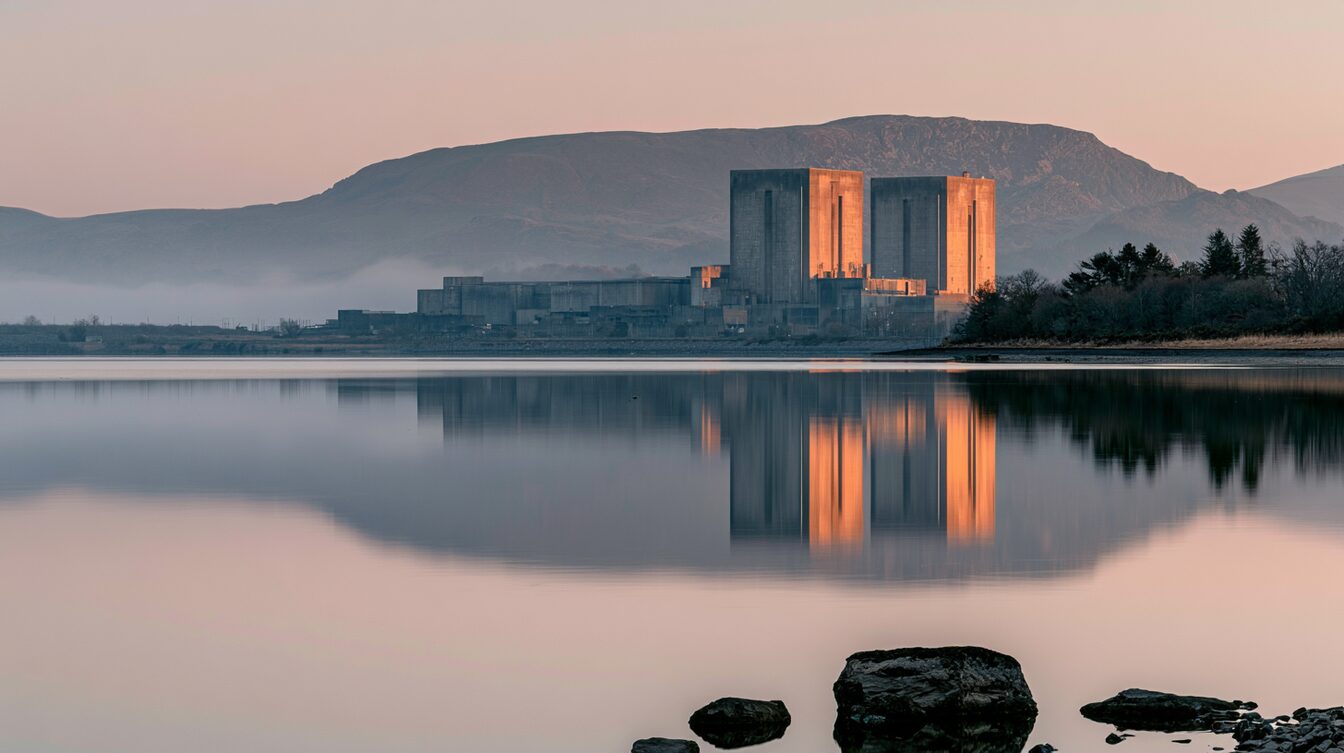
And in the middle of it all lies a lake with a reactor on its shore.
Every one of these is a story about power, and about who is trusted to handle it.
The hidden fire
Trawsfynydd nuclear power station ran two Magnox reactors from 1965 to 1991. It is the only nuclear station ever built inland in Britain — every other sits on the coast — and it was placed here because there was already a lake to cool it. For twenty-six years it generated around 470 megawatts from the strangest fuel humans have ever used: not the flame of wood or coal, but the fire hidden inside the nucleus of an atom. Welsh myth is thick with powers drawn from the earth that must be tended with care, fires that demand a guardian. Read that way — and only as a reading — the reactor is the place where people learned to wake a new kind of fire, and the lake the quiet thing that kept it cool.
The lake deserves its own line, because it too is industrial, and older than the reactor. Llyn Trawsfynydd is not natural. It was dug in the 1920s, a reservoir for the Maentwrog hydro-electric scheme, and it drowned a scatter of farms when it filled. So the water that later moderated an atomic pile was itself made to harness an earlier power. In folklore, lakes are thresholds — calm on the surface, deep with memory. Here the folklore and the engineering happen to rhyme: water, mountain and human ingenuity holding a great energy in balance.
From awakening to stewardship
Now the fire is being put out, carefully, over decades. The station stopped generating in 1991 and was defuelled by 1997; today it is the Nuclear Decommissioning Authority's lead site for taking a Magnox station apart rather than mothballing it. The intermediate-level waste has been retrieved and packaged — the final package moved in March 2026 — and a contractor is cutting the two fifty-four-metre reactor buildings down to about twenty-five. Full site clearance was, under older plans, projected as far out as the 2080s. These are facts, and they matter precisely as facts; nothing in what follows is allowed to soften them.
But notice the shape of the work. In the old stories, a power once used has to be returned to rest — the sword goes back into the lake, the cauldron is broken, the artefact is laid down when its purpose is done. The dismantling of Trawsfynydd is that shape made literal: a long, patient act of putting something powerful safely back. Nuclear stewardship runs on timescales no single life spans; decisions taken now are meant to protect people centuries ahead. The draft this essay grew from gave those who do that work a name — Ceidwaid yr Amser Hir, the Keepers of the Long Time — and it is a good name.
Decommissioning is not demolition. It is guardianship over a longer time than anyone tending it will live to see.
A myth made in the open
Here I have to be exact, because the whole of the previous essay turned on it. The hidden fire, the lake as guardian, Gwlad Idris, the Keepers of the Long Time — these are new. We are making them now, in 2026, in an office in Dolgellau. They are not ancient Welsh folklore, and they must never be allowed to pose as it. Lleu is old. The Roman fort is old. Hedd Wyn is history. This reading of the reactor is days old, and authored, and interpretive — and saying so plainly is not a weakness in it. It is the only thing that makes it honest.
This is the discipline The Landscape Remembers asked for, being practised in real time. A living mythology grows by having new stories added to it — but only if each new story carries its provenance: marked as new, attributed, dated, set beside the old ones rather than blurred into them. Welsh tradition knows the cost of getting this wrong; much of the 'ancient' druidic apparatus was invented around 1800 and passed for antiquity. So this piece does the opposite in public: it tells you exactly which threads are a thousand years old and which were spun this week. The myth is real as a made thing. It is not pretending to be found.
What it could become
The point of the story is not the story. It is what a community can do with it while the cranes are on site. A mythic interpretation layer — built with people, not delivered to them — could turn a decommissioning into something a place takes part in: workshops where young people learn the layered history of the valley; interviews that record the knowledge of the engineers and workers before they retire and that knowledge is lost; short films and animations that set the science beside the story; small interpretation points at the lakeside viewpoints where visitors already stop, each pairing a fragment of the new myth with a clear account of what dismantling a reactor actually involves.
We have run the smaller version of this already. The Dolgellau film school put the tale of Idris in front of local children and they wrote and filmed a new part of it — a community authoring its own tradition. Trawsfynydd is the same method pointed at a harder, richer subject: a place rebuilding its identity and its economy out of a century of power, with the story as the thread that holds science, history and community in one frame. A story can travel the world while the lake stays exactly where it is — which is how a place like this earns from being itself without being carried away.
The land remembers
The twentieth century brought new fire and new ambition to places like Trawsfynydd. The twenty-first asks a quieter question: how do we lay those achievements down with care? The site's future is still unsettled — there are proposals, through the Welsh company Cwmni Egino, for a modular reactor and for making medical isotopes here, though the first new small reactors went elsewhere and nothing is decided. That argument belongs to others. What belongs to the community now, whatever comes, is the meaning of the transition it is living through.
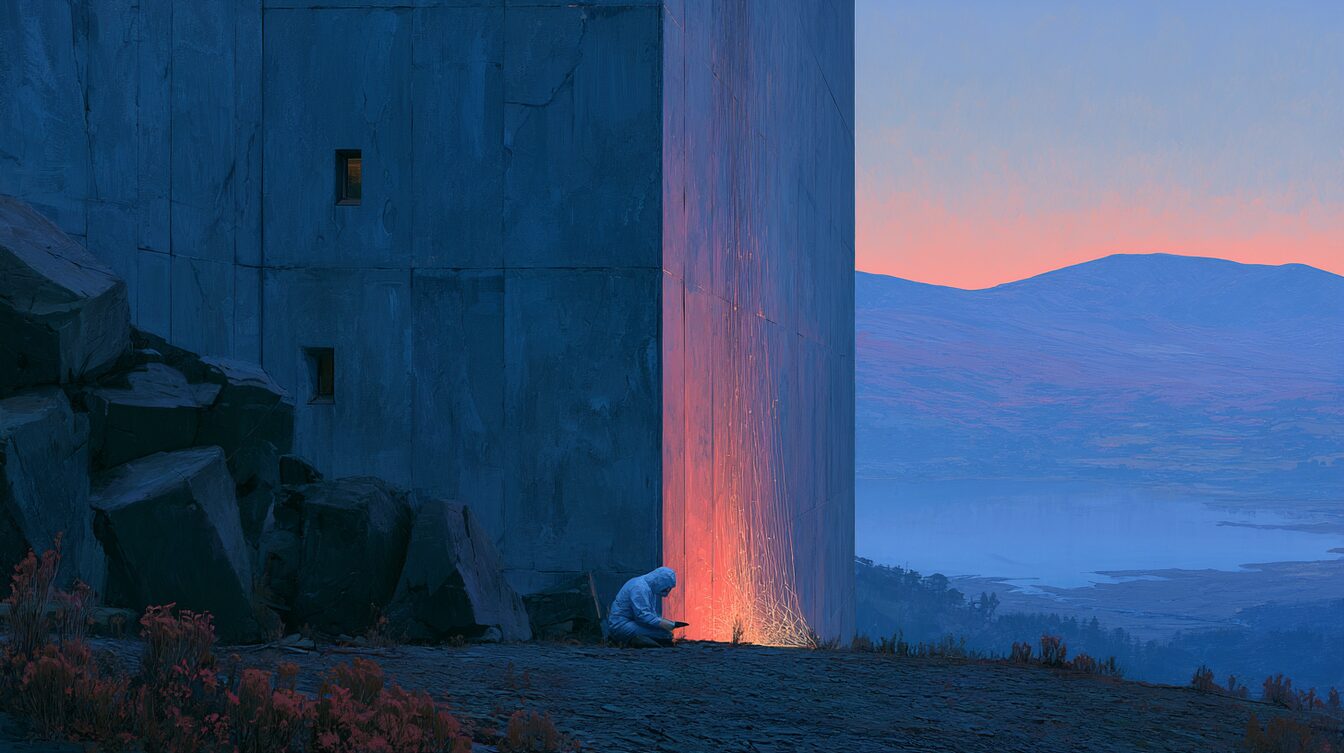
Within Whispers of Idris, the land itself remembers these passages — Roman and Norman, poet and shepherd, hydro and atom, the fire woken and the fire laid to rest. Each was a story about power and the trust to handle it. The newest one is being written now, with the cranes still working, and it is being written in the open, with its dates on. That, more than any single tale, is the point.
The hidden fire goes home. The story of it is being made now — and marked, honestly, as new.
From the Studio — the wager behind this piece, and where it connects · sources & confidence
The wager, stated so it can be judged. That a mythic interpretation layer — co-authored with the community, openly marked as new, set alongside the engineering and never over it — can turn the Trawsfynydd decommissioning into shared meaning, recorded knowledge, real youth engagement and the seed of local cultural-economic value. The Dolgellau film school already proved the method works at small scale. Signals of success here: the community co-authors rather than receives; engineers' knowledge is captured before it walks out the gate; every mythic element is everywhere marked as newly made; the factual decommissioning and safety account is preserved accurately beside it; and at least one product — a film, a trail, an installation — draws visitors and pays back locally. Kill the design if any of three things happen: the story ever blurs or softens the nuclear facts (a safety-critical site; misinformation is unacceptable), the new myth gets passed as old tradition, or the value is extracted from the community rather than kept by it. The disconfirming risk is specific to this subject: a beautiful story about atomic power could make a hazardous, century-long responsibility feel cosy. The science has to stay load-bearing and unsoftened, or the whole thing fails on its own terms.
This is the worked example of The Landscape Remembers, and the bridge to two pieces still to come: 'agentic tourism' (the interpretation points, the digital storytelling that connects a global audience to a single rooted place) and the companion on mythology as economic infrastructure (how telling a place's story afresh can pay it back). It is also the first time the notebook adds a brand-new myth to its own graph — openly, with provenance — rather than only describing old ones.
Sources & confidence: Trawsfynydd — two Magnox reactors, 1965–1991, CEGB, ~470 MW, the only inland UK nuclear station, cooled by Llyn Trawsfynydd [A/B]; Llyn Trawsfynydd a man-made reservoir built 1924–1928 for the Maentwrog hydro scheme, later reused for cooling [A/B]; decommissioning by the NDA via Nuclear Restoration Services as the Magnox 'lead and learn' site — ILW retrievals complete (final package Mar 2026), reactor buildings being cut 54m→~25m (Costain, Oct 2025), legacy clearance date ~2083 [A]; new-nuclear future (Cwmni Egino — modular reactor and medical isotopes) is a proposal and candidate of interest only, not decided; first GBE-N small reactors went to Wylfa/Oldbury [B/C — attributed]; Tomen y Mur Roman fort c.AD 78 [A] and its Mabinogi association with Lleu/Blodeuwedd [B]; Hedd Wyn (1887–1917), the Black Chair, 1917 Eisteddfod [A]. The 'hidden fire', Gwlad Idris and Ceidwaid yr Amser Hir are newly authored interpretation (2026, Arloesi Dolgellau / the author) — marked as new, not traditional [author's own].